What qualities do finance employers look for in Malta?


Last updated
June 11, 2026
Share on


Malta finance employers look for eight key qualities: integrity, technical skills (like Excel and ERP), problem-solving, communication, adaptability, flexibility, conscientiousness, and commercial awareness.
Technical accuracy is the baseline, not what sets you apart. Candidates who make the shortlist can show sound judgement, tell compelling stories with numbers, and work well across teams. The importance of these qualities varies by sector. Audit and practice firms value precision and integrity. Corporate in-house teams seek commercial empathy. Meanwhile, Malta’s iGaming and financial services employers focus on adaptability to new systems and regulations.
This article will look at why technical skills alone won’t land a job, the qualities that make candidates stand out, and how different finance sectors in Malta value these traits.
What are the eight qualities finance employers in Malta look for?
Finance employers in Malta’s key sectors seek a specific set of qualities. Here’s what they mean in practice.
- Integrity is a must. Finance roles involve confidential data, critical financial choices, and sensitive client information. Employers will overlook a skill gap before they overlook trust issues.
- Technical skills include the basics: Excel proficiency, familiarity with ERP and accounting systems, and good knowledge of reporting standards. Once you are part-qualified or fully qualified, these are seen as the minimum.
- Problem-solving is about staying effective under pressure. Finance professionals often face incomplete data, tight deadlines, and competing priorities. Employers want candidates who can find solutions, not just state what went wrong.
- Communication means breaking down complex information. Directors, operations managers, and non-finance colleagues need clear insights from financial data. If you can’t explain the numbers simply, your analysis won’t reach a wide audience.
- Adaptability is vital as finance software changes. Employers look for candidates who can quickly learn new tools and see change as part of the job, not a hurdle.
- Flexibility refers to being available during busy times, like month-end, year-end, and audit periods. Finance workloads vary, and employers value candidates who understand this and plan ahead.
- Conscientiousness is the trait that ensures reliability. Being organised, thorough, and consistent with complex data is crucial in a role where mistakes can have serious impacts.
- Commercial awareness is understanding the business context of your numbers. What is the company aiming for? What do stakeholders care about? Finance professionals with commercial awareness influence decisions; those without simply report them.
Why technical skill alone won’t get you promoted
Technical accuracy matters, but it’s just a starting point. It’s not a career strategy. In a recent Konnekt interview, three Malta finance leaders agreed: the skills that get you hired often differ from those that lead to promotions. Two common traps emerge.
The first trap is perfectionism. Accounts that are 90% correct and timely are better than those that are 100% correct but late. Holding figures for over 15 days after the period ends makes the analysis irrelevant, by then, the business has moved on. Employers notice candidates who mistake precision for value.
The second trap is treating the spreadsheet as the final product. A technically perfect set of numbers is not the end goal, it’s just raw material. The real task is to tell a story with those numbers: what happened, why it matters, and what it means for the next decision.
These qualities separate those who plateau from those who make progress in their finance career. Technical skills open the door, but communication and judgement determine what happens next.
Which four qualities actually separate shortlisted candidates?
Once technical command is in place, four key qualities set candidates apart: commercial empathy, communication, adaptability to new technology, and a willingness to challenge the status quo.
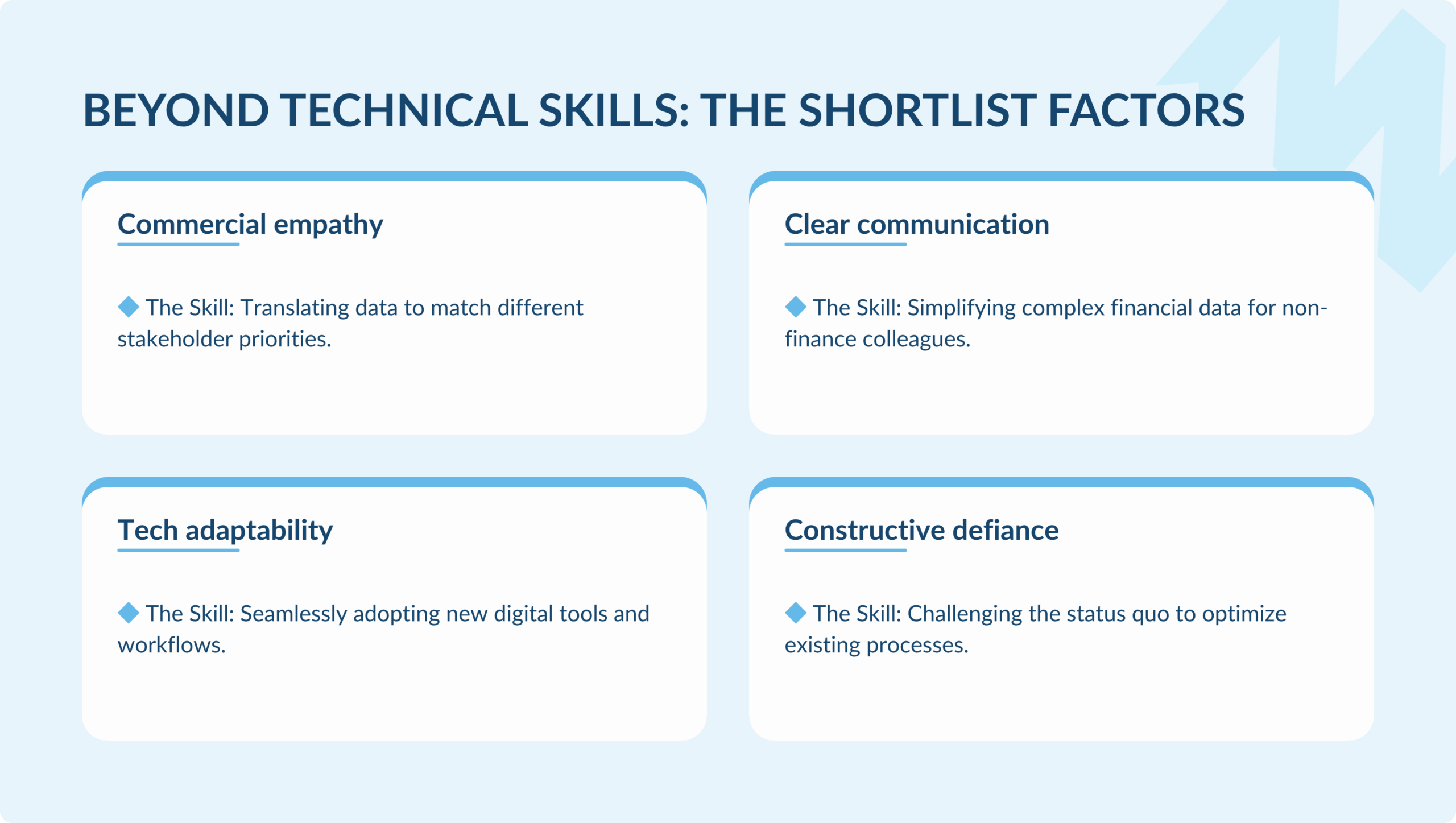
Commercial empathy is about understanding what matters to each stakeholder. The CFO wants capital implications. The operations manager wants cash flow timing. The board wants strategic risk. A finance professional with commercial empathy shapes the same underlying analysis into different conversations without losing accuracy.
Communication is the means by which this understanding is expressed. Finance professionals need to simplify complex data for directors, clients, and non-finance colleagues. Strong written communication is just as important as the analysis that underpins it.
Willingness to challenge the status quo is a quality often underestimated by candidates. In Malta, employers value those who ask, “Why do we do it this way?” rather than those who simply follow established processes. This isn’t about causing disruptions; it’s about adding value. Recognising a better approach, questioning outdated beliefs, or bringing up overlooked issues all showcase this important trait.
How Malta’s finance sectors weigh these qualities differently
The same candidate stands out differently based on their target sector. A precision-focused profile that succeeds in audit may seem inflexible in a dynamic iGaming finance team. At Konnekt, we often see candidates applying to all three sectors with the same CV, highlighting the wrong qualities for each.
The qualities themselves are universal. What changes is which one you lead with – on your CV, in your cover note, and in the interview.
| Target sector | Most-valued qualities | How to demonstrate it |
| Audit & practice | Integrity, precision, conscientiousness, meeting deadlines | Evidence of clean audit files, regulatory accuracy, managing multiple client deadlines without errors |
| Corporate in-house | Commercial empathy, communication, business-partnering | Examples of influencing a decision, presenting numbers to non-finance stakeholders, working across departments |
| iGaming & financial services | Adaptability, ERP/tech fluency, speed, comfort with regulation and change | Familiarity with finance systems beyond Excel, examples of adopting new tools or processes, working at pace |
Where to go next
Building a finance career in Malta involves more than just matching your CV to a job description. It’s about showcasing the qualities that turn technical skills into real business value. For a wider perspective, read our guide on finance and accounting careers in Malta.
Ready to take the next step? Browse current finance vacancies in Malta.
Frequently asked questions
Integrity ranks first. Finance roles handle confidential and financially critical data, and Malta’s small, interconnected market means reputational damage travels fast. Employers will overlook a gap in one technical area before they overlook a question mark over trustworthiness. Demonstrate it through a clean track record, discretion with sensitive data, and references that speak to reliability rather than only technical output.
Both, at different stages. Qualifications such as ACCA, CPA or a relevant degree get you past the initial screen, they are treated as the entry requirement. Soft skills such as communication and commercial empathy decide who is shortlisted and hired from a pool of similarly qualified candidates. Technical competence is the foundation; the qualities built on top of it are the differentiator.
Yes. Excel fluency remains a baseline expectation across almost every Malta finance role, from practice to in-house to iGaming. Increasingly, employers also expect familiarity with ERP systems and finance platforms beyond spreadsheets. The strongest candidates treat new tools and automation as an advantage to adopt rather than a threat, which is itself a quality employers actively screen for.
The four that differentiate candidates are commercial empathy, communication, adaptability, and a willingness to challenge the status quo. Commercial empathy means understanding what each stakeholder cares about and tailoring the message accordingly. Communication means translating numbers into a clear narrative.
iGaming and financial-services employers weigh adaptability, speed, and technology fluency more heavily than traditional practice firms. The pace is faster, the regulatory environment shifts often, and finance teams work closely with operations.

About the author: Emma joined Konnekt in 2021 and has been working in recruitment ever since. She began her career as a Recruitment Specialist within the Finance & Legal Recruitment Team before expanding her expertise across other sectors, including Tech. Over the years, she progressed in her role and now oversees all recruitment teams in her current position as Recruitment Operations Manager.