Relocating to Malta: What to know before you move


Last updated
June 15, 2026
Share on


Malta is a great place to build a career. It has a strong economy, English as an official language, and year-round sunshine. Its job market has attracted international professionals for over a decade. However, being a small island means it operates differently from larger European markets, so what you expect may not match what you find.
This guide shares what you need to know: the job market, cost of living, the permit process in simple terms, and practical steps to ensure a smooth relocation.
What is Malta like to live and work in?
Malta has a unique mix: a real Mediterranean lifestyle and a strong, connected economy. The island measures 316 km², which means short commutes and a local social life. Most professionals live 30 – 40 minutes from work, and the beach is usually just 20 minutes away.
English is an official language with Maltese, and most people speak it fluently. You can work in English in most sectors. Still, learning a few Maltese phrases, like Bonġu for good morning and Grazzi for thank you, can be helpful. It shows respect for the culture, which is warm and relationship-focused.
The work culture is mostly informal. Being on time is important, long lunches are common, and smart-casual dress is typical outside finance and legal jobs. However, Malta’s business community is small, so news spreads quickly. At Konnekt, we notice that your reputation can build or decline faster than in larger cities. You’ll encounter the same people in various settings: at work, networking events or beach bars. This can feel either comforting or challenging.
One surprise for newcomers: the small-island dynamic works both ways. Once you’re part of a community, Malta feels supportive. However, the first few months can feel isolating without a network. Plan for this and join activities; it gets better quicker than you might expect.
If you are a Third-Country National (non-EU), there’s a crucial point to know: your right to live in Malta depends on your job. The Single Permit allows you to work and live here. Unlike Maltese or EU nationals, you can’t simply resign and take time off. Your permit is tied to your employer. If you lose your job, a 60-day grace period starts right away. For more details, check our guide on what happens to your permit if you lose your job.
What jobs are available and which sectors are hiring?
Malta’s economy depends on a few main sectors, which is clear in the job market.
iGaming and technology are the biggest draws for international professionals. Malta was one of the first places to regulate online gaming, making the MGA (Malta Gaming Authority) licence highly sought after globally. This has created a cluster of gaming companies, many with strong tech, product, compliance, and finance teams. There’s high demand for developers, data analysts, compliance officers, product managers, and digital marketers. While competition for technical jobs is fierce, the supply is robust.
Financial services and FinTech are the second major area. Malta’s MFSA-regulated environment is home to fund managers, custodians, insurance companies, and a growing FinTech sector. Roles in accounting, compliance, risk, and fund administration are consistently in demand. Candidates with Big 4 experience or qualifications like ACCA, CFA, or CIMA are highly considered.
Healthcare has also become a key employer for international professionals, especially in nursing, allied health, and elderly care. Both public and private sectors recruit from abroad. While recognition of qualifications involves some extra steps, the ongoing demand is real.
Tourism and hospitality heavily rely on international staff. Malta’s tourism operates year-round, hiring at all levels, from front-of-house to management. The sector has a specific work permit pathway, where TCN applicants would need to complete the Skills Pass, as of March 2026.
Beyond these four sectors, professional services (legal and consulting), construction, logistics, and retail are actively hiring. Malta’s economy has grown steadily for over a decade, and the local talent pool can’t fully meet demand. This is why international professionals continue to find opportunities here.
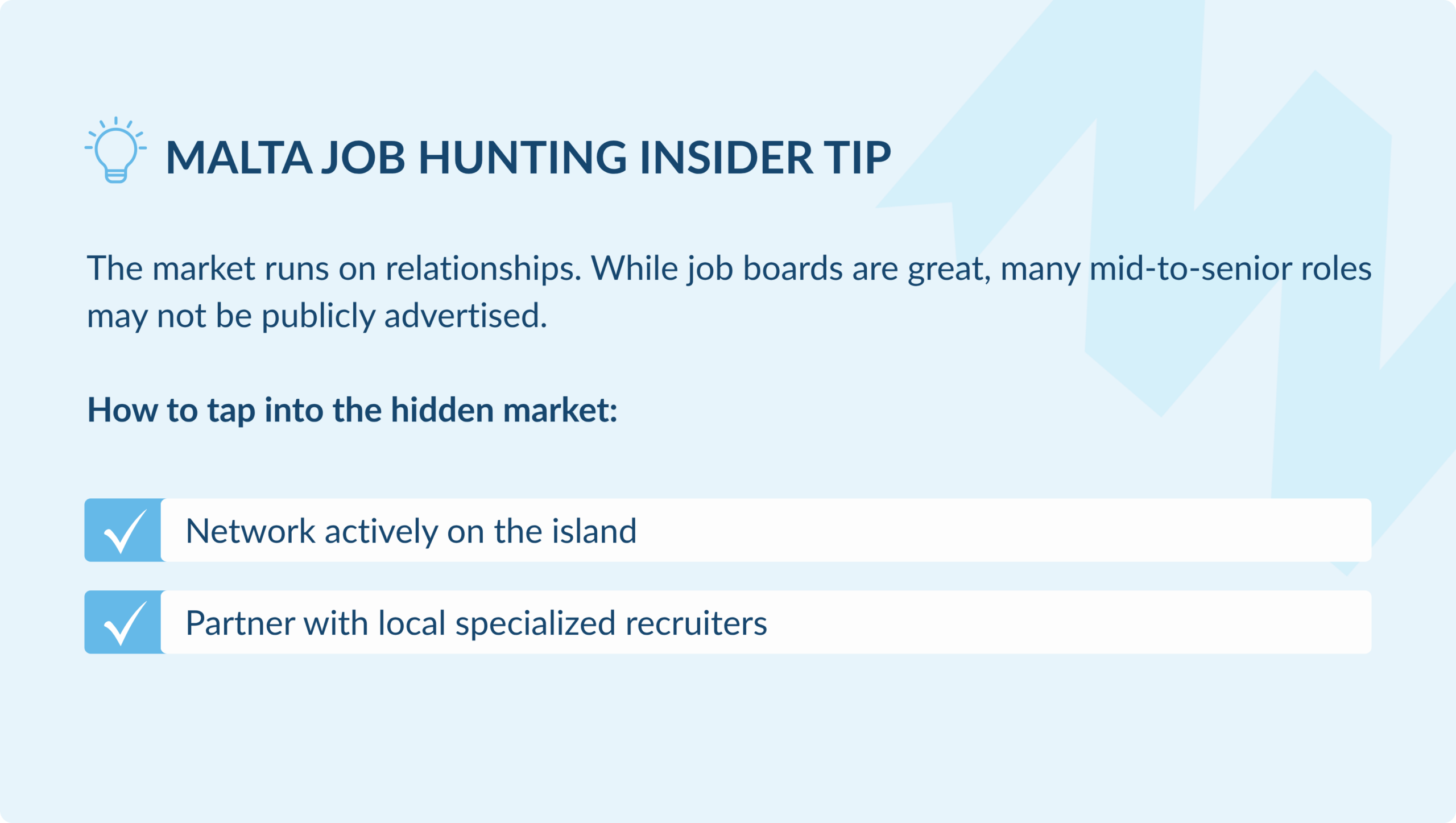
One important thing about the job market: Malta values relationships just as much as job boards. Online platforms like jobsinmalta.com and the Konnekt portal list many vacancies, but many mid-to-senior roles aren’t publicly advertised. Networking and working with recruiters who know employers across the island can help you tap into this hidden market.
What does it cost to live in Malta?
Malta is affordable by Northern European standards, but prices have been rising steadily over the past five years. A single person can live comfortably on €2,000–€2,500 a month. A couple needs around €3,000–€4,000, while a family of four should budget €3,500–€4,500.
Rent is the biggest factor. Where you live greatly impacts both cost and quality of life.
| Area | Vibe | 1-bed rent (approx.) | Commute to business hubs | Expat community |
| Sliema / St Julian’s | Cosmopolitan, busy, sea views | €1,000–€1,300/month | 5–15 min | Very high |
| Valletta | Historic, cultural, walkable | €1,000–€1,300/month | Central | Growing |
| Swieqi / Msida / San Ġwann | Residential, convenient | €900–€1,200/month | 10–20 min | Very high |
| Northern Malta (Mellieħa, St Paul’s Bay) | Relaxed, beach-focused | €800–€1,100/month | 30–50 min | Moderate |
| Southern Malta (Marsaxlokk, Marsaskala) | Traditional, very affordable | €800–€1,100/month | 30–50 min | Moderate |
Beyond rent, plan to budget about €100 – €120 per month for utilities. This includes electricity, water, and high-speed internet. High-speed broadband is common and costs around €30 – €35 monthly.
Transport is important to note. Malta lacks a rail network. The bus system serves most of the island, but it can be slow due to traffic. Most professionals either own a car, walk, or use ride-hailing apps. If you live in Sliema, St Julian’s, or Valletta and work there, you can get by without a car. However, if you live further out, having a car makes life much easier.
For Third-Country Nationals, private health insurance is mandatory. Identità requires proof of coverage worth at least €100,000 for the Single Permit application. Premiums differ by provider, age, and coverage level, so include this in your budget before you arrive.
What do you need to do before and after arriving?
The key step is this: secure a job offer before you move. Everything else follows from that.
For EU, EEA, and Swiss nationals, the process is quite easy. You can work in Malta without a permit. If you plan to stay longer than 90 days, you need to register with Identità and apply for an eResidence card. You must show proof of employment or how you will support yourself.
For Third-Country Nationals, the process has more steps and takes more time. Your employer will need to sponsor a Single Permit application through the Identità portal. This review can take up to four months. Afterward, you’ll need a National Long-Stay (D) Visa, biometrics, and your eResidence card before you can start working. Overall, this process usually takes five to six months.
Starting in March 2026, all first-time TCN applicants coming from outside the Schengen Area must complete a mandatory Pre-Departure Integration Course before arriving. The course costs €250 and must be paid through the official government portal at homeaffairs.gov.mt. Be cautious of anyone charging more or claiming to offer the course unofficially.
Once you arrive, focus on a few immediate tasks: attend your biometrics appointment at the Identità Expatriates Unit in Msida, check your Interim Receipt for Temporary Authorisation to Work (if it shows TAW, you can start right away), and collect your eResidence card once Identità confirms it’s ready.
For a detailed step-by-step permit process, check our guide to working in Malta as a TCN. If you plan to change employers while in Malta, refer to our guide to grace period, because the process differs.
How can a Konnekt recruiter help with your job search?
The most helpful thing a recruiter can do before you relocate is provide a clear picture of the job market for your background. This insight is crucial before you make any big decisions.
At Konnekt, we often talk to candidates outside Malta who are considering the move. We discuss practical details: what roles are available, which employers are hiring international candidates, and the timeline from application to start date.
If you’re seriously thinking about moving to Malta, apply for suitable jobs or register your CV on Konnekt and let us know where you are in the process.
Frequently asked questions
EU, EEA, and Swiss nationals do not need a job offer. They can work in Malta and search for jobs from the island. However, Third-Country Nationals must have a job offer before arriving. The Single Permit application is employer-led and can take up to four to six months. Arriving without a permit and looking for work is not a viable option for TCNs.
For a first-time TCN application from outside the Schengen Area, the process usually takes five to six months. The Change of Employer process for TCNs already in Malta is faster because biometric data and security checks are already in the system.
Yes, English is an official language in Malta. Majority of the population speaks it. Most professional roles are conducted entirely in English. While Maltese skills can be helpful for customer-facing jobs and roles with public authorities, they are rarely required for international hires.
Identità requires proof of private health insurance with coverage of at least €100,000 for the Single Permit application. You must have this before you submit your application, not after arriving. Malta’s public healthcare is free for eligible residents. TCNs who work legally and pay social security can access it, but the insurance requirement for the permit is separate and mandatory.
Konnekt helps candidates before they relocate in fields like finance, iGaming, technology, healthcare, and professional services. We can provide a realistic view of the job market, connect you with unadvertised roles, and advise you on timing related to the permit process. Register and upload your CV here.

About the author: Emma joined Konnekt in 2021 and has been working in recruitment ever since. She began her career as a Recruitment Specialist within the Finance & Legal Recruitment Team before expanding her expertise across other sectors, including Tech. Over the years, she progressed in her role and now oversees all recruitment teams in her current position as Recruitment Operations Manager.