Employer branding in Malta: How to win talent in a competitive market


Share on


Employer branding is how people see your company as a workplace. In Malta, this reputation matters more than many employers think. About 38% of candidates say company reputation influences their decision to apply, so a weak employer brand can turn away top talent even before they send a CV.
To build a strong employer brand in Malta, you need to align three key areas: what you say publicly, how candidates experience your recruitment process, and what your current employees say about working for you.
This guide will explore each of these areas, what candidates in Malta want, the real costs of getting it wrong, and practical steps to boost your reputation in a fast-moving market.
What is employer branding and why does it matter more in Malta?
Employer branding reflects your company’s reputation as a workplace. This view comes from current and former employees, as well as potential candidates. Every organisation has an employer brand. The real question is whether you are actively shaping it or letting it develop on its own.
In many markets, a weak employer brand can slow hiring down. In Malta, the stakes are even higher.
Malta’s workforce is only about 300,000. People frequently change jobs, and social circles overlap with work circles. Reputations spread quickly. A candidate who has a negative interview experience will share it with others you want to hire. A former employee who felt undervalued will voice their concerns, too. This feedback can reach your next candidate before your recruiter does.
The 2025 Candidate Survey conducted by Konnekt shows that 38.4% of candidates in Malta consider company reputation one of the top three reasons to apply for a job. This means over a third of potential applicants have already formed a judgment about your company before they even send a CV.
The good news is that this works in both directions. Companies with strong, clear cultures attract more applicants. These candidates are often a better fit and arrive at interviews motivated. Building that reputation isn’t just a marketing task; it results from every choice you make about how you treat people.
What do Malta candidates actually want?
Understanding your employer brand begins with knowing what influences candidate choices in this market.
The Konnekt Candidate Survey asked 500 respondents in Malta in 2025 to choose the top three factors that influence their decision to apply for a job.
| Candidate priority | % Citing as top factor |
|---|---|
| Salary and benefits | 87.8% |
| Location / remote work options | 58.8% |
| Company reputation | 38.4% |
| Role responsibilities | 36.0% |
| Company culture and values | 25.4% |
What stands out here is that company reputation is one of the top three most important factors that encourage people to apply for a job. This means that candidates often know about the company before they see the job ad, possibly through their network, or they do some research before applying. They might look at the company page and read the company website to find out more.
For a detailed look at the perks and benefits that candidates in Malta value, check out our article: What perks and benefits do employees look for in Malta?
The three pillars of employer branding
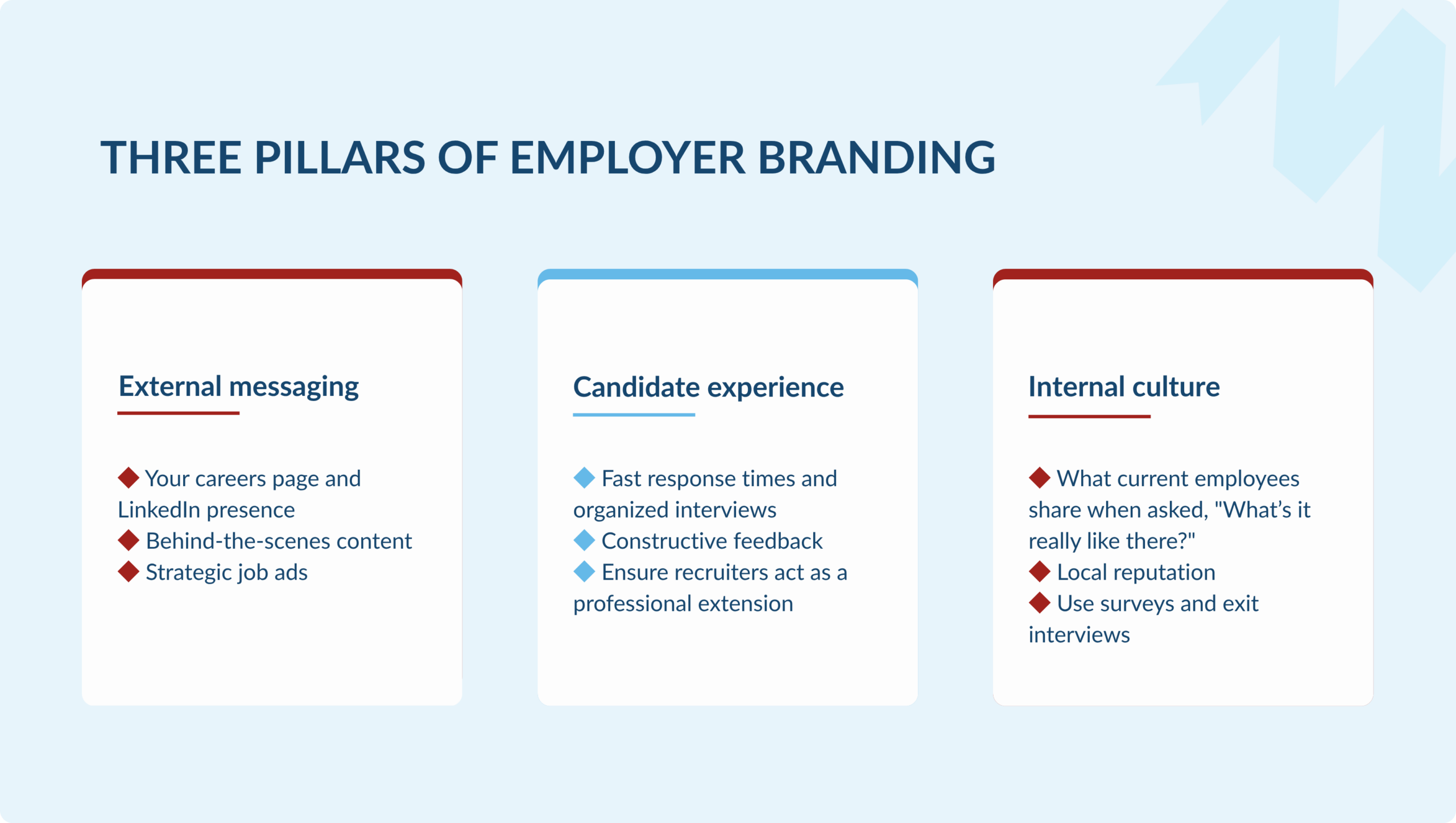
A strong employer brand depends on three main elements. They are interconnected; weakness in one can harm the others.
Pillar 1: External messaging
This is what candidates see before they engage with you: your careers page, job ads, LinkedIn presence, and the tone of your automated emails.
A common mistake is the gap between what you aspire to and reality. Job ads might describe a culture that the team wouldn’t recognise. LinkedIn posts can seem polished but feel generic. Phrases like “We’re like a family” often lack credibility.
Authenticity is more effective than polish. Sharing behind-the-scenes content, real employee views, and honest job descriptions builds trust better than curated images.
The job description is crucial too. At Konnekt, we recommend treating the job description as a marketing tool for candidates, not just an internal brief. Include a clear salary range, a narrative on why the role exists, and focus on genuine skills instead of just credentials.
Pillar 2: Candidate experience
Every touchpoint during recruitment tells candidates something about your company. How quickly you respond, whether you provide feedback, and how organised interviews feel all matter. A candidate who waits two weeks for a response after an interview, with no updates, will have a negative view of you.
The candidate experience also impacts those who don’t get the job. A respectful, timely rejection can leave a positive impression. They may apply again and spread the word.
At Konnekt, we act as an extension of your employer brand. We ensure honest and respectful communication with candidates throughout the process, as their impressions reflect on you.
Pillar 3: Internal culture
This is the toughest pillar to fake and the most vital to get right.
Your internal culture is what current employees share when speaking outside the company. It shows in what they tell friends asking, “What’s it really like there?”
In Malta, negative experiences spread quickly. Companies known for poor management or broken promises find this affects their appeal. It influences who applies, accepts offers, and refers others.
Successful companies take internal feedback seriously. This isn’t just a tick-box exercise; it’s genuine insight into where the employee experience falls short. Tools like pulse surveys, one-to-ones, and clear exit interviews help, but only if the feedback leads to real change.
What does a weak employer brand cost you?
Fewer applications, lower quality shortlists. A weak brand can turn away the best candidates. As a result, you get a smaller, less engaged shortlist.
Candidate ghosting. “Ghosting” happens when candidates disappear during hiring. This trend is partly generational but also linked to your brand. If candidates feel no loyalty to your company, they’re more likely to leave without notice.
Higher attrition in year one. This is often related to unmet expectations. Your employer brand sets the bar; the reality must match it.
Four practical steps to strengthen your employer brand
Step 1: Audit your current reputation
To enhance your employer brand, first assess where it stands. Check the data you already have: exit interview feedback, Glassdoor reviews, candidate feedback from your recruitment partner, and employee engagement survey results from your team.
The main question is: is there a gap between our public image and what people really experience?
Step 2: Close the gap between message and experience
This is the core of employer branding. If your job ads mention career growth, does your organisation have real progression paths? If your LinkedIn page shows a team-oriented culture, does management align with that? Any disparity erodes trust.
Step 3: Make your job descriptions work harder
The job description is often the first contact a candidate has with your company. A long list of requirements without a salary, a clear purpose for the role, or insights into the workplace suggests candidates are an afterthought.
We’ve seen simple fixes, like adding salary transparency, trimming the requirements, and including a genuine culture overview, to reduce candidate drop-off during applications.
Step 4: Build and manage your online reputation proactively
Platforms like Glassdoor, LinkedIn, and Google Reviews influence candidate perceptions before any contact. Claim your Glassdoor profile, respond professionally to all reviews (including negative ones), and ensure your LinkedIn page is accurate and up-to-date.
What does your employer brand look like at each stage of the candidate journey?
This table shows how employer branding is reflected throughout the process. It is a useful tool for self-audit.
| Stage | Strong employer brand | Weak employer brand |
| Job ad | Clear salary band, culture signals, skills-based requirements | Vague requirements, no salary, generic language |
| Application | Prompt, personalised acknowledgement within 24–48 hours | No response or a generic automated response |
| Shortlisting | Clear criteria, respectful communication whether progressing or not | No communication; candidates left guessing |
| Interview | Structured, on time, interviewers prepared, candidate questions welcomed | Disorganised, late, interviewers clearly unprepared |
| Post-interview | Feedback provided promptly, outcome communicated within agreed timeline | Extended silence; feedback vague or absent |
| Offer | Prompt, aligned to what was discussed, clear next steps | Delayed, lower than indicated, administrative confusion |
| First week | Structured onboarding, warm welcome, manager available | Left to figure it out; onboarding not prepared |
| Year 1 | Regular check-ins, visible development path, feedback welcomed | Disengagement, broken promises, no support |
How a recruitment partner can strengthen your employer brand
A key part of building a strong employer brand during recruitment is working with the right strategic partner. At Konnekt, we do more than just send CVs. We act as brand ambassadors, taking the time to understand our customers’ company culture, core values, and the real day-to-day experience of working there. This is why we place so much importance on meeting clients in person, ideally at their offices, so we can get to know them and capture the pulse of their culture as closely as possible.
With this insight, we can communicate an honest and compelling picture to candidates. We set clear expectations and explain what truly makes the company a good place to work, helping candidates see where they might fit, not just in terms of skills, but also personality and values. This approach leads to more engaged new hires who are more likely to stay, helping companies reduce turnover and build stable, long-lasting teams.
If you need help to attract candidates, contact us to arrange a meeting with our recruitment team.
Frequently asked questions
Employer branding refers to your company’s reputation as a place to work. This encompasses how you write job ads, conduct interviews, manage people on a daily basis, and what your current employees say about their experience working for you. Every company has an employer brand, but the key difference lies in whether it is managed effectively or left to chance.
There is no set timeframe for building a strong employer brand. However, you can expect to see noticeable improvements in your reputation and the quality of job applications within 6-12 months of consistent effort. Addressing specific issues, such as improving reviews or refining job descriptions, can yield faster results. Nevertheless, the underlying cultural shift required to sustain a strong employer brand is an ongoing process, rather than a one-time project.
No, employer branding is relevant to companies of all sizes. In fact, it can be even more crucial for smaller companies in Malta, as they often rely on their reputation and culture to attract top talent. Larger multinationals may have the advantage of name recognition and scale, but smaller employers can compete by showcasing their unique culture and values. By doing so, they can appeal to candidates who prioritise culture fit and are willing to choose a smaller company over a bigger one.
Your Employee Value Proposition (EVP) consists of the benefits, opportunities, and experiences you offer to employees in exchange for their skills and commitment. Employer branding, on the other hand, refers to the way you communicate and demonstrate this proposition, both internally and externally. In essence, the aEVP is the core offering, while employer branding is the means by which you express and promote it.
To compete with larger companies, focus on the unique advantages that small businesses can offer, such as proximity to leadership, direct impact, genuine flexibility, and a distinct culture that is not lost in bureaucracy. The key to success lies in making these advantages visible, not just through social media posts, but through every aspect of the recruitment process, from job ads to onboarding.

About the author: Rebekah Cauchi joined Konnekt in 2023 as a Recruitment Consultant, where she connects clients and candidates with optimal career opportunities. She is passionate about cultivating strong professional relationships and guiding individuals through the recruitment lifecycle, consistently ensuring a mutually beneficial match for both organizations and job seekers.