Why Maltese companies are hiring TCN talent in 2026


Last updated
June 15, 2026
Share on


Malta’s labour market has never been more international. With domestic talent pools unable to keep pace with the island’s sustained economic growth, Maltese employers are increasingly turning to Third-Country Nationals to fill critical roles.
But the decision to hire TCN talent is not simply a gap-filling exercise. For employers who understand the data, it is a strategically sound workforce decision. TCNs stay longer than EU nationals, rarely change employers voluntarily, and bring skills that span every level of an organisation, from operational roles to senior professional positions.
Key takeaways
- TCNs have a median length of stay in Malta of 3.3 years, significantly longer than the 2-year median for EU nationals
- Around 63% of foreign nationals never change employer during their time in Malta
- TCN talent spans all sectors and skill levels, not just blue-collar or entry-level roles
Why Malta’s labour market increasingly depends on TCN talent
Malta’s workforce has undergone a structural transformation. With 38.6 per cent of the workforce now made up of foreign workers, for many employers the real question is no longer about simply attracting them, but about keeping them.
What has changed in 2026 is the regulatory environment surrounding this hiring. The Malta Labour Migration Policy (2025) has significantly tightened the rules by introducing mandatory Pre-Departure Courses, stricter employer termination thresholds, and the prohibition of cash wage payments. These changes raise the compliance bar for employers, but they also create a more stable, predictable TCN workforce for those who meet that bar.
The retention myth: what the data says about TCN loyalty in Malta
The most persistent misconception among Maltese employers about TCN hiring is that foreign workers, particularly non-EU nationals, are inherently transient. They come, they work for a year or two, and then they leave. The data from the Central Bank of Malta tells a different story.
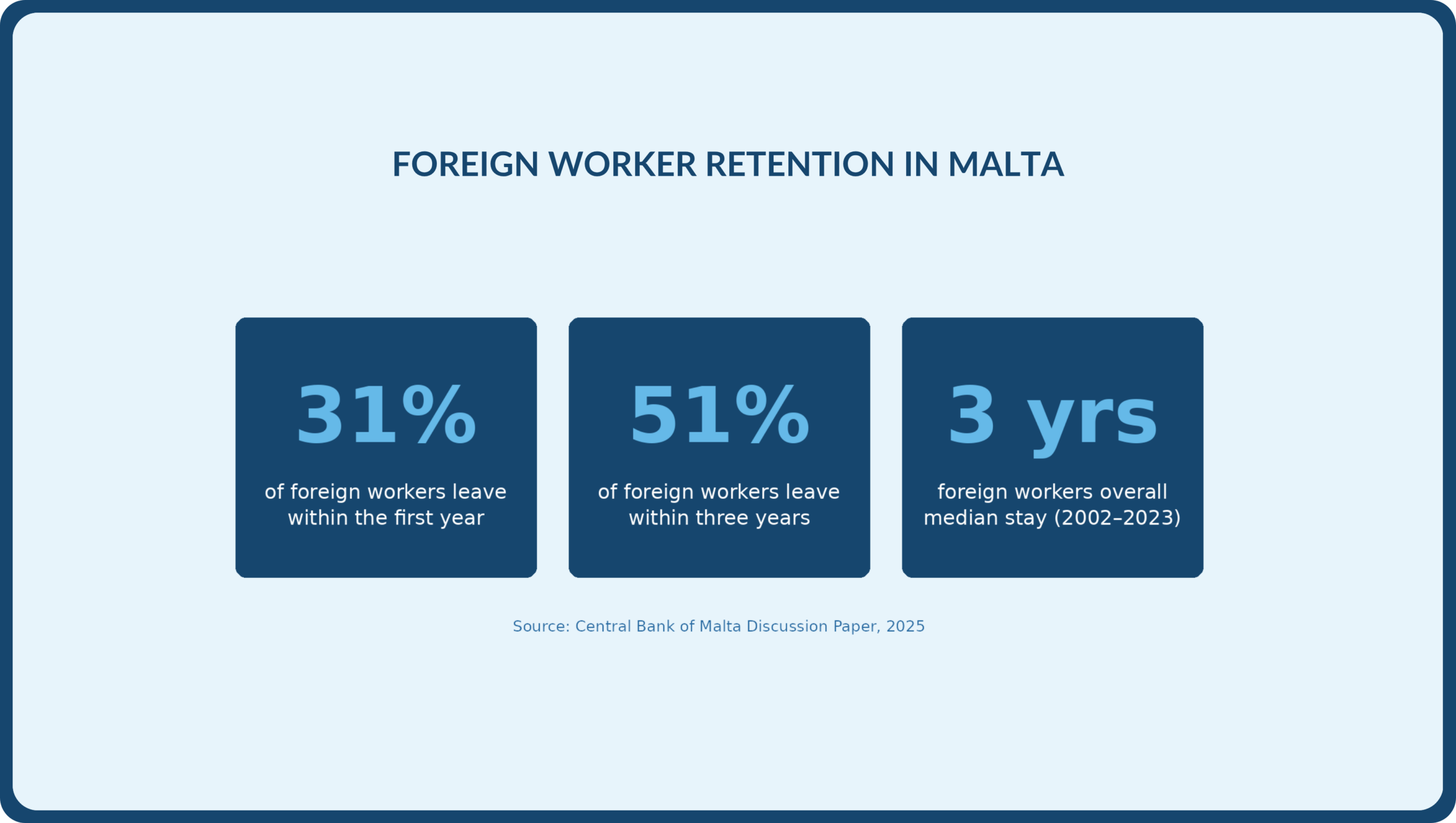
Around 31 per cent of foreign workers leave Malta within their first year, and roughly 51 per cent depart within three years. The foreign workers’ overall median length of stay is three years.
Read in isolation, those figures sound like a high-turnover workforce. But the picture becomes more nuanced when you separate EU nationals from TCNs. Third-country nationals (TCNs), workers from outside the EU, actually stay in Malta longer than their EU counterparts. The median stay for TCNs is 3.3 years, compared to just 2 years for EU nationals.
This is a counterintuitive finding that most employers are not aware of. The workers most commonly assumed to be the highest flight risk are, on average, staying longer than their EU peers.
The loyalty data is equally compelling. Notably, around 63 per cent of foreign nationals never change employers during their time in Malta. Once they settle in, the vast majority are not job-hopping. They stay with the same organisation that first hired them.
What drives departure when it does happen? The data suggests that 41 per cent of those who leave Malta move to other EU countries rather than returning home, meaning the competition for this talent is pan-European, not just local. Malta is competing with every other EU member state for this workforce. Retention is not just about permit policy or administrative processes, but is shaped by the employment experience within a given business: how workers are treated, whether they see career progression, how well they are integrated into the organisation, and of course, whether their conditions reflect what is fair and competitive in the market.
The implication for employers is that TCN retention is not primarily an immigration problem. It is a management and culture problem, and one that is entirely within the employer’s control to address.
TCNs are not just filling blue-collar roles
One of the most persistent and damaging misconceptions in Maltese employer circles is that TCN hiring is primarily a solution for manual, low-skilled, or entry-level positions. This framing is both inaccurate and commercially limiting.
TCNs currently work across the full spectrum of the Maltese economy. In financial services, non-EU nationals fill compliance, risk, and technology roles that require advanced qualifications and often specific language skills not readily available in the domestic market. In healthcare, TCN doctors, nurses, and allied health professionals are integral to both public and private sector operations. In technology, software engineers, data analysts, and cybersecurity specialists from outside the EU are employed by some of Malta’s largest iGaming and fintech companies. In professional services such as legal, accounting, consulting, TCN talent fills roles that require years of specialised experience.
The practical consequence of this misconception is that some Maltese employers rule out TCN candidates for professional or managerial roles before they have even looked at the available pool. In a tight labour market, that is a costly assumption. The question worth asking is not “does TCN hiring apply to my sector?” – it almost certainly does. The question is whether your organisation has the processes and the mindset to onboard and retain international talent at every level.
Which sectors are seeing the biggest demand for TCN talent in 2026?
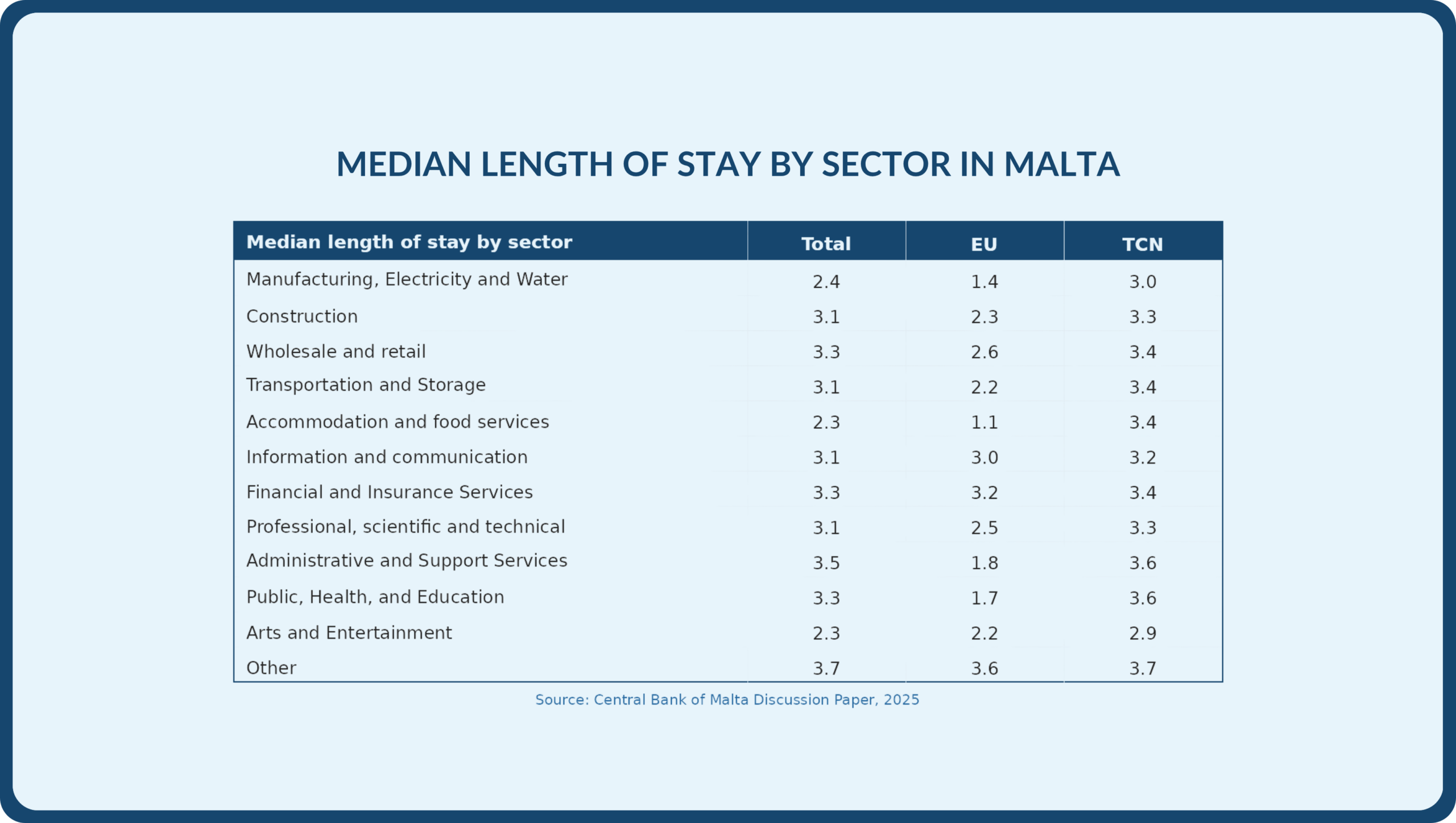
While TCN talent spans all industries, some sectors are experiencing particularly acute shortages that make TCN hiring not just beneficial but operationally essential. The Central Bank of Malta’s sector-by-sector data on median length of stay offers a useful lens.
The data becomes even more revealing when broken down by sector. Across Accommodation and Food Services, EU nationals stay a median of just 1.1 years. TCNs in the same sector stay for 3.4 years. For an industry built on service consistency and trained staff, this differential has direct operational implications. Hospitality employers who have historically been reluctant to invest in TCN onboarding because of perceived turnover risk are, according to the data, making the wrong calculation.
The sectors with the strongest TCN demand heading into 2026 include:
- Construction and infrastructure – major public and private development projects are driving sustained demand for skilled trades, site management, and engineering roles that the domestic workforce cannot fully supply
- Hospitality and food services – Malta’s tourism-dependent economy requires year-round staffing at volumes that make TCN hiring structurally necessary, particularly in kitchen, front-of-house, and management roles
- Healthcare and elderly care – an ageing Maltese population and expanding private healthcare sector are creating acute shortages in nursing, care work, and allied health professions
- Financial services and iGaming – Malta’s position as a regulated EU jurisdiction for financial services and online gaming creates demand for compliance officers, technology specialists, and multilingual client-facing professionals
- Logistics, warehousing, and transport – e-commerce growth and supply chain expansion have created sustained demand for drivers, warehouse operatives, and logistics coordinators
- Retail – particularly in tourist-heavy areas, multilingual staff with service experience are increasingly sourced internationally.
In high-turnover sectors such as accommodation and food services, manufacturing and transport, TCNs often outlast their EU counterparts. The sectors with high retention rates are not struggling with TCNs. They have a sector issue. Poor working conditions, shift patterns, and unclear career paths make it tough for any worker to settle down, no matter where they come from.
This is an important point for employers to internalise: if your sector has a retention problem with TCN workers, the data suggests the root cause is more likely to be found in the employment experience than in the nationality of the employee.
The business case in plain terms
For an employer weighing the decision to hire TCN talent, the evidence points in one clear direction. TCNs stay longer than EU nationals in most sectors. The majority never change employer voluntarily. They fill roles across every skill level and sector, not just the ones that domestic candidates decline.
The remaining variables, compliance process, documentation, permit timelines, are manageable with the right support. Employers who have already built TCN hiring into their workforce strategy consistently report that the administrative investment pays back within the first year of a stable hire.
Talk to Konnekt about your TCN hiring needs
At Konnekt, we maintain an active pool of TCN candidates already living in Malta across a wide range of industries and skill levels, from hospitality and construction to financial services, healthcare, and technology. Speak to our employer team to tell us what you are looking for, and we will match you with verified, permit-ready candidates who fit your roles and your organisation. Additionally, if you require assistance navigating the work permit process and renewals for TCNs, the Konnekt Payroll team can help you handle the compliance and paperwork.
Frequently asked questions
Yes, according to data from the Central Bank of Malta. The median length of stay for TCNs in Malta is 3.3 years, compared to 2 years for EU nationals. In sectors like accommodation and food services, the gap is even wider, TCNs stay a median of 3.4 years versus just 1.1 years for EU nationals in the same sector.
No. TCNs currently work across every sector and skill level in Malta, including financial services, healthcare, technology, legal and professional services, and senior management roles. Research suggests that approximately half of non-EU workers in Malta are overqualified for their current positions, indicating a talent pool that is frequently more skilled than the roles they are placed in.
The 2025 policy raises compliance requirements, mandatory Pre-Departure Courses, termination thresholds, bank transfer wage payments, but it does not reduce access to TCN talent for compliant employers. For businesses that follow the correct process, the policy creates a more stable and predictable TCN workforce. The primary impact falls on employers who previously relied on informal or non-compliant hiring practices.

About the author: Nicole Hili Timbol is a Candidate Engagement Lead, specialising in sourcing and placing blue-collar professionals across various industries. Committed to building strong client relationships and connecting skilled candidates with the right career opportunities.