Handling a counter-offer: How to decide without regret


Last updated
June 11, 2026
Share on


A counter-offer is your employer’s way to keep you from leaving. This often includes a salary increase, a title change, or both. Whether you should accept it depends on one key factor: does the offer address why you wanted to leave?
This article gives you a practical way to decide. It covers what counter-offers really mean, how to evaluate them, how to respond professionally, and what to expect after your decision.
This article is part of our career planning guide.
What is a counter-offer, and why does your employer make one?
A counter-offer is what your employer gives you when they find out you’re thinking of leaving. It often comes after you resign or mention another job offer. Your employer might offer better pay, extra benefits, or a new title to persuade you to stay.
Employers consider the costs of replacing staff. Hiring someone new means spending time and money on ads, interviews, and training. It also means dealing with lost productivity. Usually, a few thousand euros in salary is cheaper than months of hiring and lost output.
This is especially true in competitive fields. In iGaming, FinTech, and IT, candidates often get multiple offers. Employers know this well. In finance, candidates with three or more years of experience in Malta are valuable. Employers don’t want to lose them, so they make bigger counter-offers.
Counter-offers can be reactive or pre-emptive. The reactive one happens when you resign, and your manager calls you in to talk. The pre-emptive one occurs when your employer learns you’re job hunting and tries to keep you before you get an offer. Both types use similar decision-making, which we will discuss below.
At Konnekt, we often ask candidates how they will respond when their manager wants to talk about a new offer. It may seem like a hypothetical question, but it usually isn’t.
Be clear on the real reason you were looking to change your job
Before you respond to any counter-offer, you need to be clear about why you started looking in the first place.
According to the Konnekt candidate survey commissioned in 2025, salary and benefits are the top motivator for changing jobs, cited by 56.3% of candidates. Career advancement comes in close behind at 46%. Location and flexibility, including remote work options, also feature prominently. These three factors account for the vast majority of reasons people change jobs.
Here’s the key point: counter-offers usually fix salaries but do little for the other two factors.
If salary was your main reason and the counter-offer matches the market rate, you have a tough choice. Both options are financially similar, so think about the other aspects. However, if you felt stuck in your career, if the culture didn’t fit, if your manager was an issue, or if you couldn’t see a future in your role, a pay raise won’t change that. It just hides the problems. The issues will still be there.
At Konnekt, we often see candidates getting a counter-offer, taking it for the higher pay, and returning to job hunting within six months. The reasons for wanting to leave remain unresolved. A salary boost may create short-term satisfaction, but it won’t change your reporting line, growth potential, or team dynamics. Those are structural issues that a counter-offer can’t fix.
Another thing to consider: once you show you want to leave, your relationship with your employer changes. Trust is affected. Some managers appreciate the chance to keep a valued team member. Others may start preparing for your exit. You often won’t know which situation you’re in.
How to evaluate a counter-offer: a practical framework
The best way to assess a counter-offer is by asking four key questions.
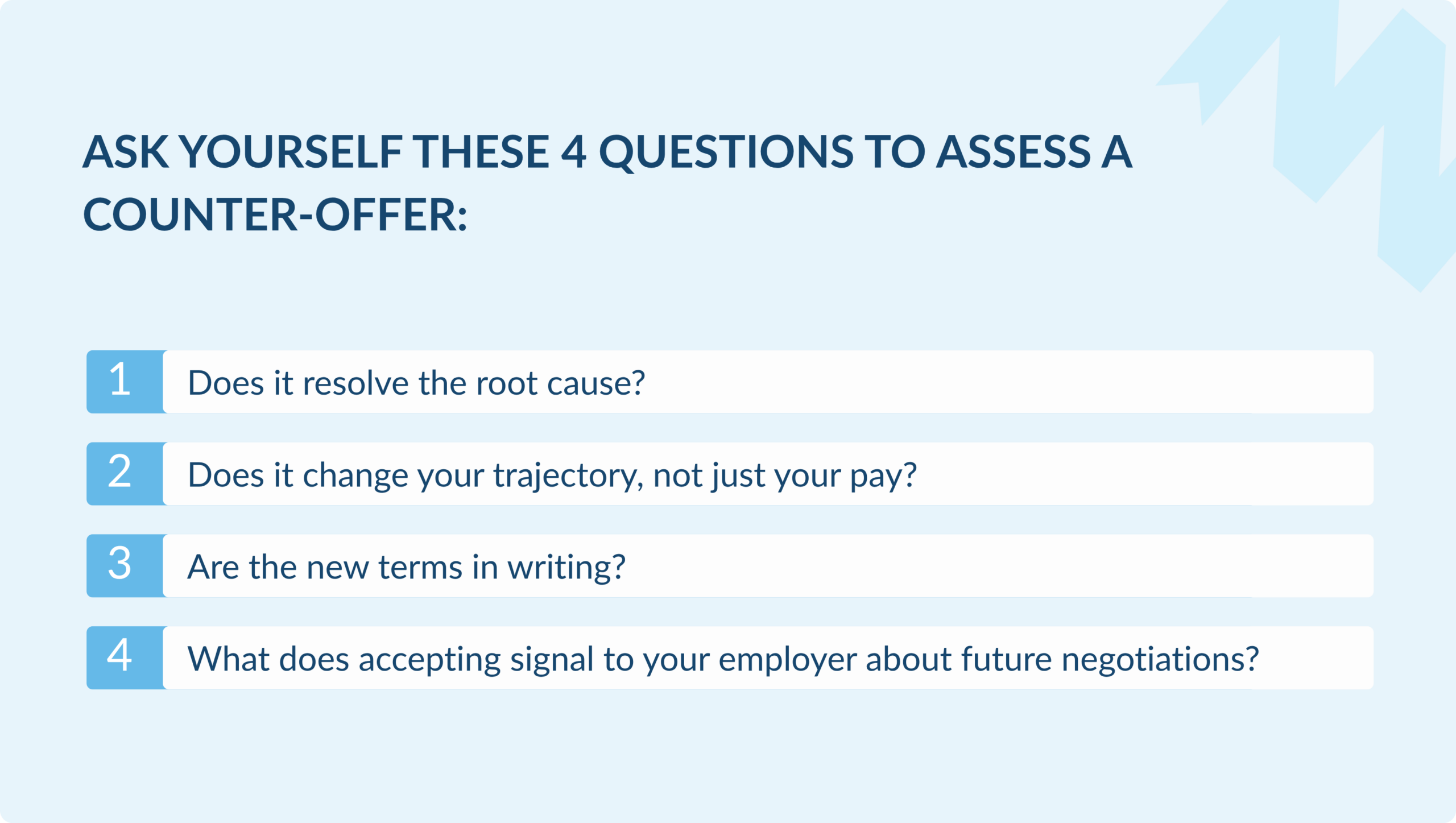
1. Does it resolve the root cause? Focus on the root issue, not just the surface one. If salary is why you’re leaving, does the new figure match or exceed what you’d earn in the new role? If your reason for leaving is different, does the counter-offer address it clearly in writing? If not, the counter-offer only delays the problem.
2. Does it change your trajectory, not just your pay? A salary boost affects your take-home pay, while a trajectory change affects your career in three years. Consider if accepting this counter-offer improves your professional position in the medium term. If the new role offers clear progression but the counter-offer only matches your current salary, you risk trading future growth for present comfort. If you are weighing a career move more broadly, our career planning guide covers how to set that framework before you are under the pressure of a live offer.
3. Are the new terms in writing? Any verbal commitment made during the counter-offer, like a promotion review or new title, needs to be in writing. Before you agree, ask for the revised terms in writing. A good employer won’t mind this request.
4. What does accepting signal to your employer about future negotiations? This is the question many candidates overlook. Accepting a counter-offer shows your employer how you react to the threat of leaving. Some employers will respect this, while others may see you as a flight risk or someone who leverages outside offers. You can’t control how this information is perceived, but it should influence your decision.
Counter-offer decision table
| Your primary reason for leaving | What a counter-offer typically addresses | Recommendation |
| Salary below market rate | ✅ If the revised figure is at or above market | Accept it |
| Career progression stalled | ❌ Rarely changes reporting line or scope | Decline, ask for a written promotion plan instead |
| Culture or management issues | ❌ Cannot change culture or your direct manager | Decline |
| Genuine doubts about the new role | Not directly | Pause – use the counter-offer to buy decision time; revisit the new offer |
| Salary + trajectory both improved, in writing | ✅ Both root causes addressed with committed terms | Accept – with written confirmation before you respond |
How to respond professionally, whether you accept or decline
The quality of your response is as important as the decision itself.
If you are accepting: Thank the employer clearly. Confirm the revised terms in writing before saying yes verbally. Once you have the written confirmation, stop negotiating. Going back for more can quickly damage goodwill and may not benefit you in the long run.
If you are declining: Be direct and warm. You don’t need a detailed explanation, but a professional one is good. You might say: “I’m truly grateful for this offer and for all I’ve learned here. After careful thought, I’ve decided to take the new opportunity. I want to ensure a smooth transition.” That’s enough. Don’t leave doors open if you’re not planning to return. It’s kinder to be clear.
On timing: Employers may create urgency. They might say, “We need an answer by the end of the day,” or “The board has approved this, and it won’t be on the table forever.” You deserve a reasonable amount of time to consider a big career decision. If you have another offer with a deadline, inform your employer and ask for their revised terms within that timeframe. Reasonable employers will understand.
The written rule: Whatever you agree to, get it in writing. This applies to the counter-offer terms from your current employer, the formal offer letter from a prospective employer, and your acceptance. Verbal commitments can be easily misremembered by both sides.
What to expect next after you decide
If you accepted: The first few weeks may feel stable. The salary is better, and the relationship might feel renewed. Plan for a 90-day self-review: Are the reasons you wanted to leave still there? Has anything changed, or was the counter-offer just about money? If the issues still exist at the 90-day mark, recognise it early. Make a plan rather than waiting until frustration builds up again. When the time comes to move forward with your job search, it is worth making sure your CV is in strong shape and that you are prepared for interviews.
If you declined: Handle your notice period as professionally as possible. It’s tempting to mentally check out, but resist. You never know when a past manager might be your reference, a former colleague could be your next client, or a company you left might have a role you want in five years.
Frequently asked questions
There’s no legal deadline under Maltese employment law. Your employer sets the timeline based on your outstanding offer. Ideally, respond within two to four working days. If you have a deadline from your new employer, share it with your current employer and ask for their revised terms. Taking longer than a week without explanation can signal indecision and strain both relationships.
You don’t have to, but it can help if you need a short extension on their offer. Many employers in Malta will grant a brief extension if you’re genuinely considering a counter-offer. It shows you’re a valued employee. However, don’t use the counter-offer to negotiate a higher new offer unless you’re ready to decline if they say no. Using a counter-offer as leverage can create tension from the start.
Your employment rights stay the same. You leave under normal notice terms in your contract. However, the informal relationship changes. Accepting a counter-offer and then leaving within six to twelve months is quite common. It usually doesn’t harm your career permanently, but it can affect how your employer and their network view your reliability. If you leave after accepting, ensure you have a strong reason and act professionally during your exit.
One honest conversation is reasonable, especially if the counter-offer addresses salary but not other commitments, like a title change or a promotion review. Avoid prolonged discussions that leave both sides uncertain and your current employer feeling like they’re in an auction. Clearly state what would make you stay, let them respond once, and base your decision on that.
There’s no single figure. In finance and accounting, counter-offers can be significant, sometimes reaching levels that employers were hesitant to approve through regular reviews. In iGaming and FinTech, where candidates often hold multiple offers, counter-offers tend to arrive quickly and at competitive levels. In sectors with collective agreements, like manufacturing, the room for negotiation may be limited, regardless of the employer’s desire to keep you.

About the author: Emma joined Konnekt in 2021 and has been working in recruitment ever since. She began her career as a Recruitment Specialist within the Finance & Legal Recruitment Team before expanding her expertise across other sectors, including Tech. Over the years, she progressed in her role and now oversees all recruitment teams in her current position as Recruitment Operations Manager.