How to choose a career you love: A practical guide for job seekers


Last updated
June 11, 2026
Share on


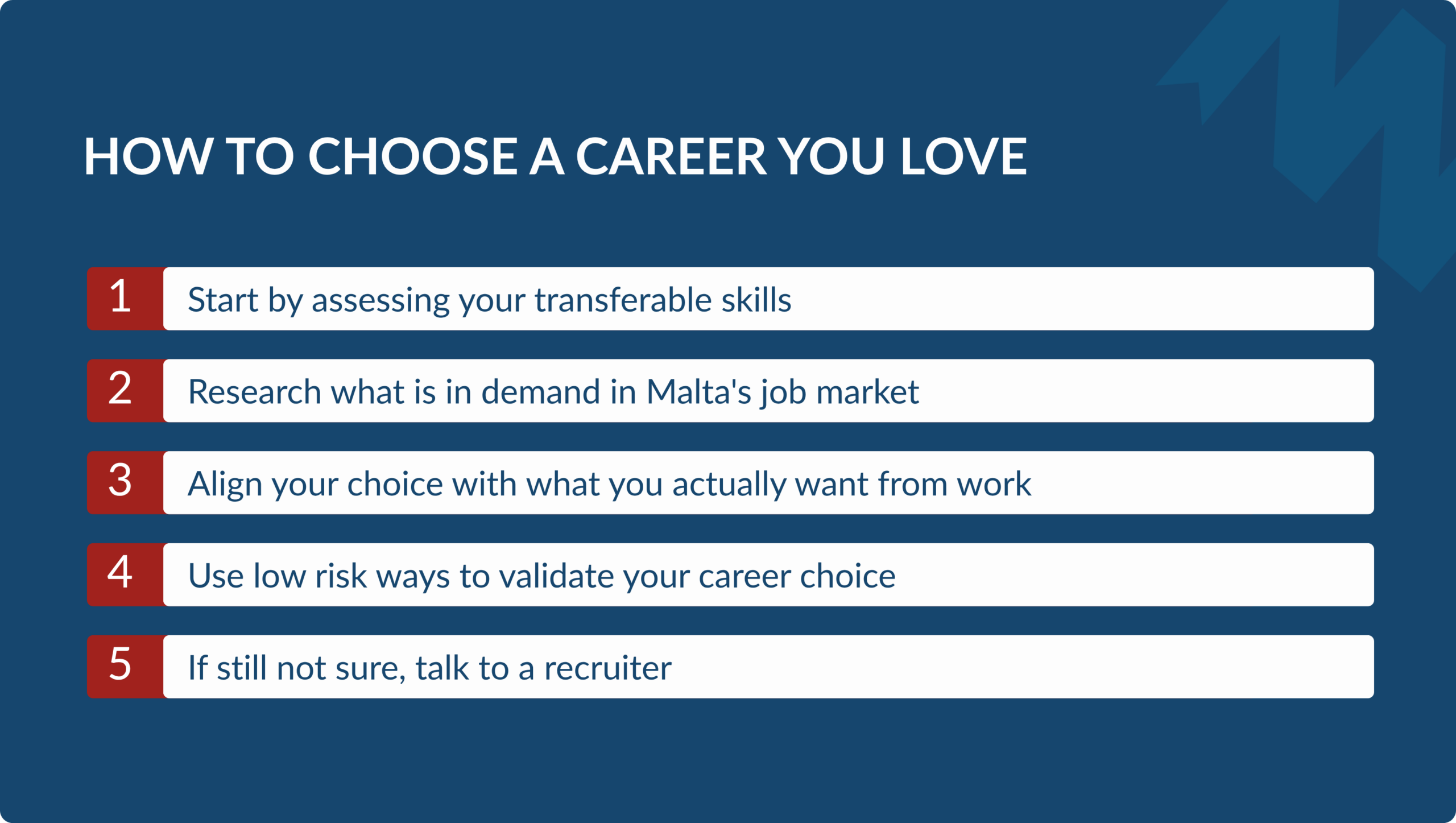
Choosing a career you love begins with knowing your skills, what Malta’s job market rewards, and what you want from work besides a salary. Many struggle to decide because they don’t use structured self-assessments or market research. The most effective method has three steps: identify your transferable strengths, check them against real demand in Malta’s key sectors, and match your choice with personal priorities.
A 2025 survey by Konnekt of 500 Maltese workers shows that 45.8% are motivated by career advancement when changing jobs. If a career lacks a clear progression path, it won’t hold your interest for long, no matter how attractive it seems initially.
Start with what you are actually good at
The best starting point for career choice is competency, not passion. Mastery often leads to passion, rather than the reverse. What you are genuinely good at forms a stronger base for a fulfilling career.
Start by assessing your transferable skills. List the projects or tasks where you saw clear outcomes. What did they have in common? Were you synthesising complex information, managing relationships, building or fixing systems, persuading people, or organising processes? These patterns highlight competencies that apply across different sectors.
At Konnekt, we often see candidates undervalue their transferable skills. Many look for a direct title match instead of focusing on their competencies. For instance, a candidate with B2C marketing and creative freelancing experience wanted to move to a B2B marketing role. At first, this seemed unlikely because she lacked B2B experience. However, her strengths in strategic communication and audience analysis were truly transferable. The recruiter used a Past-Present-Future approach. She highlighted the candidate’s transferable strengths, ongoing upskilling, and how her background met the employer’s needs. As a result, she got the job. Her competencies were always there; they just needed the right framing.
Malta’s job market makes this strategy effective. The island’s economy centres on key sectors: iGaming, financial services, aviation, hospitality and tourism, professional services like legal and accounting, and a growing healthcare sector. Cross-sector moves are common. For example, an operations manager from hospitality could move to iGaming operations. Similarly, a compliance analyst from financial services might shift to iGaming regulation. Knowing your core skills helps clarify these transitions for you and potential employers.
If you’re unsure of your strengths, speak with a recruiter who knows your sector. They see the same skills across many CVs and can highlight your transferable strengths more clearly.
For tips on showcasing these strengths in your CV, check our guide on writing a CV for jobs in Malta.
Understand what is in demand in Malta’s job market
Before choosing a career path, check if there’s real demand in Malta. It’s less meaningful to pursue a job you love if there are only three vacancies each year for that role.
The best way to research this is through market observation. There are around 1,800 live vacancies on jobsinmalta.com at any given time. Browsing these listings is not just about job searching; it’s a way to research your career. You can see which roles are common, which sectors are hiring, what experience levels are needed, and what employers want in job descriptions.
Here are the main sectors in demand in Malta:
iGaming: Roles include compliance, regulatory, tech, product, marketing, customer operations, finance, and legal. This sector hires broadly and has a clear career ladder.
Financial services: The Malta Financial Services Authority (MFSA) regulates many licence holders, creating steady demand for compliance, AML, fund administration, and corporate governance roles.
Aviation: Technical engineering, ground operations, and commercial aviation roles are available, though there’s a tight supply of qualified candidates.
Professional services: Accounting, audit, legal, and consulting roles are always in demand by the Big 4 other local and boutique Corporate Service Providers.
Understanding which sectors are growing, stable, or facing challenges is crucial for your career decision. A path in a growing sector offers more opportunities than one in a declining field affected by automation or regulations.
Align your choice with what you actually want from work
Choosing a career based solely on salary can lead to early regret. Salary is important, but it’s just one factor in a mix that affects long-term job satisfaction.
A 2025 survey by Konnekt of 500 Maltese workers found that when considering a job change, salary and benefits ranked first (65.4%). Flexibility and remote work came next (51.4%), followed by career advancement opportunities (45.8%). It’s essential to think about these aspects before making a decision. A high salary in a role without growth can create the same dissatisfaction within eighteen months. Flexibility is crucial in Malta’s small geography. Commuting from Ħal Qormi to Sliema isn’t long by European standards, but a strict nine-to-five with no hybrid option can deter candidates who have enjoyed more flexibility.
At Konnekt, we often see candidates regretting their choices because they focused on salary over growth potential. They took the highest offer without checking for advancement opportunities. Two years later, they find themselves stuck at the same level, often earning less than the market rate, and back where they started.
Use the table below to assess your values against career factors before deciding.
Career Values Prioritisation Matrix
| What you want from work | What to look for | Malta sectors that typically deliver this | Questions to ask at interview |
| Salary growth | Clear pay bands, annual review structure, performance-linked progression | Financial services, iGaming (commercial and tech roles), legal | “What does the pay review process look like after year one?” |
| Career advancement | Defined promotion criteria, visible career ladder, internal mobility | Big 4, iGaming operations and compliance, aviation | “Can you describe the career path for someone starting in this role?” |
| Work-life balance | Hybrid or remote option, predictable hours, reasonable workload | Tech and product roles, marketing, some professional services | “What does a typical week look like? Is there flexibility on start/finish times?” |
| Learning and development | Training budget, study leave, mentorship culture | Big 4 (structured training), iGaming (fast-moving environment), fintech | “Is there a training budget? Do you support professional qualifications?” |
| Job stability | Established employer, essential function, recession-resistant sector | Public sector, financial services, healthcare | “How has headcount changed in the last two years?” |
| Meaning and impact | Cause-connected work, customer-facing outcomes, team purpose | Healthcare, NGO, education, sustainability roles | “How does this role contribute to the organisation’s wider mission?” |
For a broader overview of career planning in Malta, see our career planning guide for Malta.
Low-risk ways to validate a career direction
The best way to know if a career suits you is to test it out first. Reflection has its limits. At some stage, you need real-world evidence.
Here are some low-risk testing options in Malta:
Informational interviews. Reach out to people in the role or sector you’re interested in. LinkedIn makes this simple. A 20-minute chat with someone who has been in the role for three years can provide lots of insights. Ask what they do daily, what surprises they’ve encountered, and what they wish they had known.
Temporary and contract roles. Temp and contract work genuinely help you test a career. In Malta, there are many contract roles. A three-month contract gives you a feel for the sector’s culture, pace, and daily routine before you accept a permanent offer.
Stretch projects in your current role. If you’re already employed, look for projects that relate to your target area. A finance professional curious about compliance might get involved through cross-team projects. A marketing executive thinking about product roles can volunteer for a product launch. Using internal opportunities is often a missed chance for career testing.
One key point to understand is the counter-offer dynamic. When candidates explore new careers and get an offer, their current employer may respond with a counter-offer, like a salary increase or a new title. The counter-offer may solve the immediate problem but rarely addresses the underlying issues. At Konnekt, we’ve seen that candidates who accept counter-offers often return to the job market within months.
For tips on getting ready for a new role or sector, see our article on job interview preparation in Malta.
What to do when you are still not sure
If you’ve tried the above and still feel uncertain, talking to a recruiter familiar with the Malta market can help. A good recruiter won’t tell you what career to choose. Instead, they’ll explain which roles candidates like you move into successfully, which sectors are hiring, and where the best opportunities are right now. This insight can speed up your decision-making process.
Konnekt’s team works across all major sectors in Malta and can provide a clear view of where your background fits and what options are realistic. Register and upload your CV, and our recruiters will get in touch with you.
Frequently asked questions
Start by focusing on what you’re good at, not just what you love. Make a list of tasks and projects where you achieved clear results. Identify the skills behind those successes, like communication or problem-solving. Then, look for roles in Malta’s job market that require those skills.
Malta has high demand in iGaming and online technology, including compliance and marketing. Financial services and fintech roles are also sought after, especially in AML and fund administration. Aviation and various professional services, like accounting and legal, are in demand too. About 1,800 live vacancies are listed on jobsinmalta.com at any time. Checking current listings is a smart way to gauge real market demand before deciding.
No, changing careers at this stage is common in Malta. Local recruiters frequently handle such transitions. The key is to identify transferable skills from your current job to your new target sector. In areas like iGaming and financial services, hiring managers understand these skills well. The challenge isn’t age; it’s how you present your experience.
Try low-risk actions first. In Malta, temporary and contract roles in iGaming, financial services, and hospitality let you gain real experience in a field before accepting a permanent position. Informational interviews on LinkedIn with people in your target role are free and often more helpful than formal research. Short-term exposure is better than long-term assumptions.
The best careers combine your skills with market demand, using your values as a guide. Relying solely on passion can be misleading; it often follows mastery. Focusing only on market demand can lead to high-paying jobs that may leave you unsatisfied. A practical approach is to match your strengths with what Malta’s market values, then apply your priorities such as salary growth and meaning to refine your options.

About the author: Emma joined Konnekt in 2021 and has been working in recruitment ever since. She began her career as a Recruitment Specialist within the Finance & Legal Recruitment Team before expanding her expertise across other sectors, including Tech. Over the years, she progressed in her role and now oversees all recruitment teams in her current position as Recruitment Operations Manager.