How to write a CV for jobs in Malta: Complete guide


Last updated
June 12, 2026
Share on


Your CV can be the reason a recruiter calls you or not. In Malta’s job market, recruitment is fast-paced and good candidates are snatched up quickly. Your CV has only 8 to 12 seconds to impress before it goes to the next pile.
This guide shows you how to write a CV that stands out. You’ll learn the preferred format for Malta employers, what to include, and what to leave out. We’ll also cover how to handle your first job, the impact of ATS and online applications, and where to find reliable free templates. Use the sections below to jump to what you need.
What this guide covers
- Europass or original CV: which is more effective in Malta?
- What information to include in your Malta CV and what to leave out
- How long should your CV be when applying for jobs in Malta?
- Writing a CV with little or no experience in Malta
- CV formatting and ATS: what you need to know for online applications
- Free CV templates for Malta: what to look for
- Common mistakes Malta recruiters encounter on a weekly basis
Europass or original CV: which works better in Malta?
The Europass format aims to standardise CVs across the EU, and it does this well. However, this standardisation can be a drawback. Recruiters in Malta often find it forgettable. Its rigid layout makes all CVs look alike, so your skills and experience struggle to stand out during the first glance. At Konnekt, we often see a strong candidate submit a Europass CV, get overlooked, and then resubmit with an original format, leading to better outcomes.
That said, Europass has its uses. It’s suitable for public-sector roles, applications to EU bodies, and jobs that specifically require a standard format. It’s also helpful for those new to CV writing who need a dependable template to start with.
The table below offers a quick guide on which format works best in different situations.
| Situation | Recommended format |
| Private sector – finance, iGaming, IT, legal | Original / custom |
| Creative roles – marketing, design, media | Original / custom (showcase personality) |
| Senior and executive roles | Original / custom |
| Public sector Malta | Europass or as specified |
| EU body or European institution application | Europass |
| First CV, unsure where to start | Europass as a starting point, then adapt |
| Applying via an ATS/job portal | Either – ATS compatibility matters more (see below) |
For a full walkthrough of both formats with templates, see our free CV templates for Malta guide.
What information to include in your Malta CV and what to leave out
A Malta CV has eight key sections. Everything else is optional or can even be harmful.
The eight essentials:
- Name and contact details – include your full name, a professional email, phone number, and LinkedIn profile URL. Just your city is enough; no need for your full address.
- Professional summary or profile – write 3-5 sentences at the top. State your current level, core specialisms, and what you seek. Be specific, not generic.
- Work experience – list jobs in reverse chronological order. Start with the most recent role.
- Education – also in reverse chronological order.
- Skills – only relevant hard skills. If you have both technical and language skills, separate them.
- Language skills – important in Malta. List each language with your proficiency level (native, fluent, working).
- Achievements or key projects – mention these within your work experience, not as a separate section.
- References – simply state, “References available on request.” Don’t provide contact details until asked.
What to leave out:
Date of birth is the most common mistake. Under EU anti-discrimination guidelines, Malta employers should not ask for it, and including it suggests you may not be aware of current norms. It is best to leave it off.
A photograph is optional, but we do not recommend using one as a bad photo can hurt you more.
Hobbies and interests should only be included if they are genuinely relevant to the role. For example, “reading and socialising” does not add anything, whereas “Club captain, Valletta FC Amateur League” might be relevant, depending on the position.
You do not need to state “available for interview” as it is assumed. Similarly, you can omit “references available on request” in full, as everyone takes it for granted.
How long should your CV be when applying for jobs in Malta?
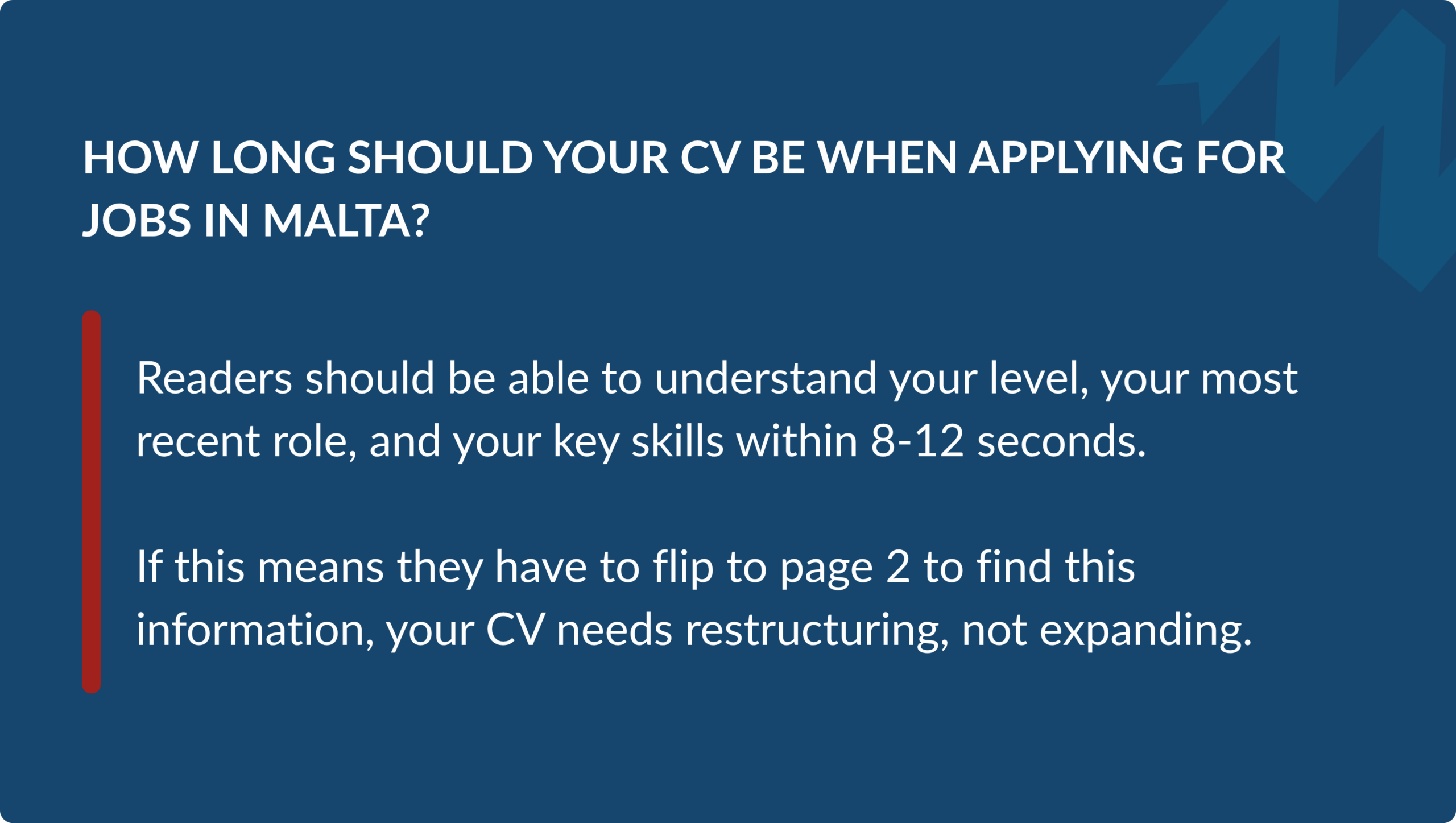
The target is two pages maximum for experienced candidates and one page for graduates or those with fewer than three years of experience. Malta’s recruitment market is active, and recruiters and hiring managers have to process a significant number of applications, so the initial scan is quick. If your most important credentials are not visible in the first half of page one, there is a real chance they will not be seen at all.
For candidates with over 10 years of experience, two pages can feel restrictive. However, the discipline is to cut out information by quality, not just quantity. This means removing older roles to just one line each, such as “2010-2013: Junior Accountant, XYZ Ltd”, removing generic responsibilities, and removing anything that is not relevant to the type of role you are applying for now.
How to write a CV with little or no experience in Malta
If this is your first job or you have limited work history, shift your focus to your skills and character. Employers in Malta looking for graduates or entry-level candidates want people they can develop. A straightforward, honest CV that highlights your initiative can be more important than an extensive work record.
What to include when experience is limited:
- Education – share your results, not just the qualifications. Mention your final-year project or dissertation if it’s relevant.
- Voluntary work and community involvement – these experiences matter. Roles in student societies, charities, or sports clubs show you are reliable and can work with others.
- Summer jobs and part-time work – even if these jobs aren’t in your field, they demonstrate responsibility and commitment.
- Language skills – in Malta’s global job market, speaking multiple languages is a real asset. Maltese, English and Italian are all in demand.
- Online learning and certifications – list any relevant online courses you’ve completed, such as those from Google or LinkedIn Learning.
A common mistake for first-time applicants is leaving blank spaces on their CV. This suggests a lack of effort rather than experience. Fill your CV with what you genuinely have. Being honest and complete is better than being sparse.
CV formatting and ATS: what you need to know for online applications
Malta’s recruitment market uses applicant tracking systems, but they are not used as aggressively as in large UK or US corporations. Most small and mid-sized Maltese employers still review CVs manually. If you’re applying through an ATS-enabled recruitment platform, your CV will be parsed automatically before a human sees it.
Here’s what to know:
Always submit as PDF for online applications. This is because Word format can change depending on the reader’s software, but a PDF keeps your formatting the same. The idea that you should send your CV in Word so it can be edited is no longer relevant, as PDFs have been the standard for years.
Keep formatting ATS-readable. Using heavy design elements like text boxes, columns, and graphics in your CV might confuse the ATS and cause problems. It’s best to use a clean, single-column layout with standard headings like Work Experience, Education, and Skills.
Name your file properly. CV.pdf” is not a helpful file name, but “Firstname-Lastname-CV-2026.pdf” is. Hiring managers have to deal with a lot of attachments, so giving your file a clear name shows you are professional.
For email applications: attach your CV as a PDF and include a short email message. Do not copy and paste your CV into the email, as this will disrupt the formatting and may give a bad impression.
Free CV templates for Malta: what to look for
A good CV template offers a clear, professional layout. Overly designed templates can prioritise style over substance, and substance is what gets you hired.
When evaluating a free template, check three things:
- Is it ATS-compatible? Single-column layouts, standard fonts (Arial, Calibri, Garamond), and no text boxes or embedded graphics. If it looks impressive but uses heavy design elements, it may not parse correctly through online application systems.
- Does it put your name and most recent role at the top? The first thing a reader sees matters. Templates that bury your headline section or open with a photo and a decorative border are prioritising aesthetics over readability.
- Is there enough space to write properly? Templates with tiny font sizes and minimal white space encourage candidates to fill them, which usually means padding with weak content. A good template has breathing room.
If you want a Europass template, it is available free at europass.europa.eu.
For a curated selection of free, Malta-tested templates, see our resource of free CV templates for Malta.
Common mistakes Malta recruiters encounter on a weekly basis
These are the patterns Konnekt’s recruiters notice every week.
Vague job descriptions instead of achievements. The most common CV weakness we see is using vague job descriptions instead of achievements. For example, “Responsible for managing social media accounts” does not tell a recruiter much. On the other hand, “Grew Instagram engagement by 40% over six months by introducing a weekly video content series” clearly shows what you can do. Wherever possible, replace job responsibilities with specific, quantified results.
Weak achievement language. The verbs you choose are crucial. “Managed a team” is a flat statement. “Led a team of seven” is an improvement. However, “Led a team of seven through a system migration completed on schedule and under budget” is what will get you noticed. Using action verbs like led, built, improved, reduced, delivered, launched, and negotiated will help you stand out. A recruiter should be able to see your impact at a glance.
An unprofessional email address. Unfortunately, this is still a common issue. If your email address is an old nickname, create a new one before you apply. A standard format is to use your first name and last name at a major email provider.
Including date of birth. As noted earlier, it is best to leave your date of birth off your CV. It does not add any value and may potentially lead to unconscious age bias.
No structure or clear trajectory. A CV that lacks structure and a clear trajectory can be difficult to read and may give the impression that you do not know what you want. Structure your experience to show a coherent direction, even if your career has taken a few pivots.
Overstating language skills. In Malta’s bilingual market, recruiters often test language proficiency. If your CV claims you are fluent in Maltese but your spoken Maltese is basic, it will be apparent during the interview. Be honest about your language level. Claiming “working proficiency” is fine, but claiming to be fluent when you are not will damage your credibility.
Spelling and grammar errors.It is essential to proofread your CV carefully. Read it aloud, ask someone else to review it, and then read it again. Even a single typo can be disqualifying.
Once your CV is in good shape, your next challenge is the interview itself. See our complete job interview preparation guide for Malta for what comes next.
Key takeaways
A strong Malta CV should be no more than two pages, compatible with ATS, and focused on achievements rather than job descriptions. For most private-sector roles, a unique format will outperform the Europass template, but the content is more important than the layout. Given Malta’s bilingual market, your language skills should have a prominent section of their own. You should avoid including your date of birth, unprofessional contact details, or vague lists of responsibilities. Ensure your name, current role, and key skills are visible within the first 10 seconds of reading.
Your CV secures the interview. What you do during the interview is a separate skill – and one that is just as important to prepare for.
Browse current jobs in Malta on konnekt.com and register with Konnekt to be matched with roles that fit your profile. Our recruiters review every registration and will be in touch if there’s a match in our current pipeline.
Frequently asked questions
For most private-sector jobs in Malta, a clean and unique CV format is best. Recruiters find Europass functional but forgettable. Its rigid structure can hide a candidate’s true strengths during quick scans. Use Europass mainly for public-sector or EU roles. For finance, iGaming, IT, legal, and creative positions, a well-organised original format works better. Aim for a maximum of two pages.
Your CV should be two pages for those with experience and one page for graduates or those with less than three years’ experience. Recruiters in Malta review many applications quickly, often in just 8 to 12 seconds. Ensure your most recent role, core skills, and seniority are clear on the first page. If key details are on page two, they might go unread.
Including a photo is optional and not expected. At Konnekt, we do not actually recommend including one, as a poor-quality image might harm your chances of getting an interview.
Focus on your skills and character instead of prior job history. Include your education, volunteer work, student activities, part-time jobs, language skills, and any relevant certifications. Employers in Malta look for candidates they can develop. Show initiative, reliability, and multilingual skills. A CV that accurately reflects your abilities is stronger than one filled with vague content.
No, a Europass CV is not necessary for most private-sector jobs in Malta. It’s suitable for public-sector applications and cases where a standard format is required. For most roles, especially in finance, iGaming, IT, legal, and business, an original, well-structured CV is preferred as it clearly showcases your strengths.
Common mistakes include: listing job responsibilities rather than achievements, using weak action verbs, having an unprofessional email, including your date of birth (omit this), lacking a clear narrative in job history, overstating language skills, and making spelling or grammar errors. The key issue is the gap between “responsibilities” and “achievements,” which heavily influences whether your CV gets shortlisted.

About the author: Emma joined Konnekt in 2021 and has been working in recruitment ever since. She began her career as a Recruitment Specialist within the Finance & Legal Recruitment Team before expanding her expertise across other sectors, including Tech. Over the years, she progressed in her role and now oversees all recruitment teams in her current position as Recruitment Operations Manager.