Make your CV stand out: Tips from Konnekt recruiters


Last updated
June 12, 2026
Share on


Your CV has only 8 to 12 seconds to make an impression before a recruiter moves on. The difference between a shortlisted CV and one that isn’t often comes down to three things: it should focus on achievements, have a clear and consistent format, and speak directly to the job being advertised.
At Konnekt, one of Malta’s oldest recruitment agencies, we’ve been placing candidates since 2007. Our recruiters review thousands of CVs each year in finance, iGaming, IT, legal, and general roles. These trends often separate the CVs that get callbacks from those that don’t.
Why most CVs don’t survive the first 10 seconds
A recruiter looking at 80 to 100 applications doesn’t read every CV fully. They scan quickly. In those first moments, they seek three things: your current or last role, your seniority level, and if your skills match the job.
If any of this information is buried on page two, hidden in dense text, or lost in a cluttered layout, your CV goes in the no pile. This doesn’t mean you are unqualified, but it means you’re not communicating clearly.
At Konnekt, we often see this with strong candidates. A well-qualified applicant submits a CV that lacks clear structure – no headline, experience in a non-standard order, or key skills scattered throughout.
The solution isn’t a redesign. It’s about structure. Your name and current title should be at the top, followed by a brief professional summary of three to five sentences. Your most recent role needs to be visible in the first third of page one. Everything else should build on that.
One practical rule: if a friend who doesn’t know your field can’t tell what you do and how experienced you are within ten seconds of seeing your CV, it needs restructuring.
What’s the difference between achievements and responsibilities on a CV?
The most common weakness we see across CVs is listing responsibilities rather than a record of achievements.
Responsibilities describe what your job was. Achievements describe what you did with it. Recruiters already know what a Finance Manager or a Customer Success Executive does. What they cannot infer is whether you were good at it.
Compare these two ways of writing the same experience:
| Responsibilities version | Achievements version |
| Managed social media accounts for the company | Grew Instagram engagement by 40% in six months by introducing a weekly video content series |
| Responsible for team oversight | Led a team of seven through a system migration delivered on time and under budget |
| Handled customer complaints | Reduced average complaint resolution time from 5 days to 2 days, achieving a 92% satisfaction score |
| Supported finance function | Automated three monthly reporting processes, saving approximately 12 hours of manual work per month |
| Managed supplier relationships | Renegotiated contracts with four key suppliers, achieving a 15% cost reduction in Year 1 |
The pattern is always the same: action verb + what you did + the measurable result. You don’t need a number for every bullet point, but quantify when you can. Numbers add clarity. Specific details build credibility.
If your role focuses on processes, like compliance or administration, the same idea applies but in a different way. Saying “Ensured all client files met MFSA reporting requirements for 40 regulated entities” is more impactful than “Responsible for regulatory compliance.” Highlight the scope and standard, even without a headline metric.
Strong action verbs to use: led, built, reduced, delivered, launched, negotiated, implemented, redesigned, managed, grew, improved, streamlined, resolved, introduced, secured.
Verbs to avoid: responsible for, assisted with, helped to, involved in, supported. These are passive and don’t provide much information to the recruiter.
What CV format do Malta recruiters actually prefer?
Keep it consistent and readable
Recruiters see many CVs daily. What they value most is clarity. Use one font, maintain consistent spacing, and follow a logical order. Clean alignment is key.
Stick to a single-column layout with standard headings: Professional Summary, Work Experience, Education, Skills, and Languages. Avoid text boxes, multiple columns, or graphics. These may look good on screen but might fail when processed by some applicant tracking systems (ATS), which many Malta employers use for initial screening.
Font choice matters less than consistency. Use Arial, Calibri, or Garamond in 11pt or 12pt for body text. Headings should be 14pt or 16pt. Avoid anything smaller than 10pt. If your CV needs 9pt font to fit, it’s time to trim it down.
The Europass question
The question of Europass comes up often. Based on years of recruiter feedback, we advise avoiding it for most private-sector roles in Malta.
Europass standardises CVs across the EU, which can be a problem. When every CV looks the same, none stand out. Its format focuses too much on completeness, leading to long, dense documents that are hard to scan.
There are exceptions: public sector roles, applications to EU bodies, or positions that specifically request a standard format. For finance, iGaming, IT, legal, and general private-sector roles, a unique format is better. Check out this article to find downloadable CV templates for Word.
Photo or no photo?
This is a common question, and the honest answer is: leave it off.
In Malta’s private sector, including a photo is not standard. A professional headshot adds no relevant information about your suitability. In fact, a poor-quality photo, like a casual selfie or a cropped social media picture, can hurt your chances. We’ve seen strong candidates rejected because an informal photo gave a bad first impression.
If you must include a photo, it needs to be high quality: a professional headshot with a neutral background, formal attire, and good lighting. Think LinkedIn profile, not a phone selfie. If you can’t meet that standard, it’s better to use the space for more content about your experience.
A photo may be expected in creative roles where personal presentation is important, such as media or PR. Even then, check the job description first.
How do you tailor your CV to a specific job?
Sending a generic CV to every role is a sure way to get filtered out. Recruiters can quickly tell if a CV was not tailored for their role. This shows disinterest, not efficiency.
Tailoring doesn’t mean rewriting your CV for every application. It means making targeted changes that reflect the job description’s language and priorities.
A practical process
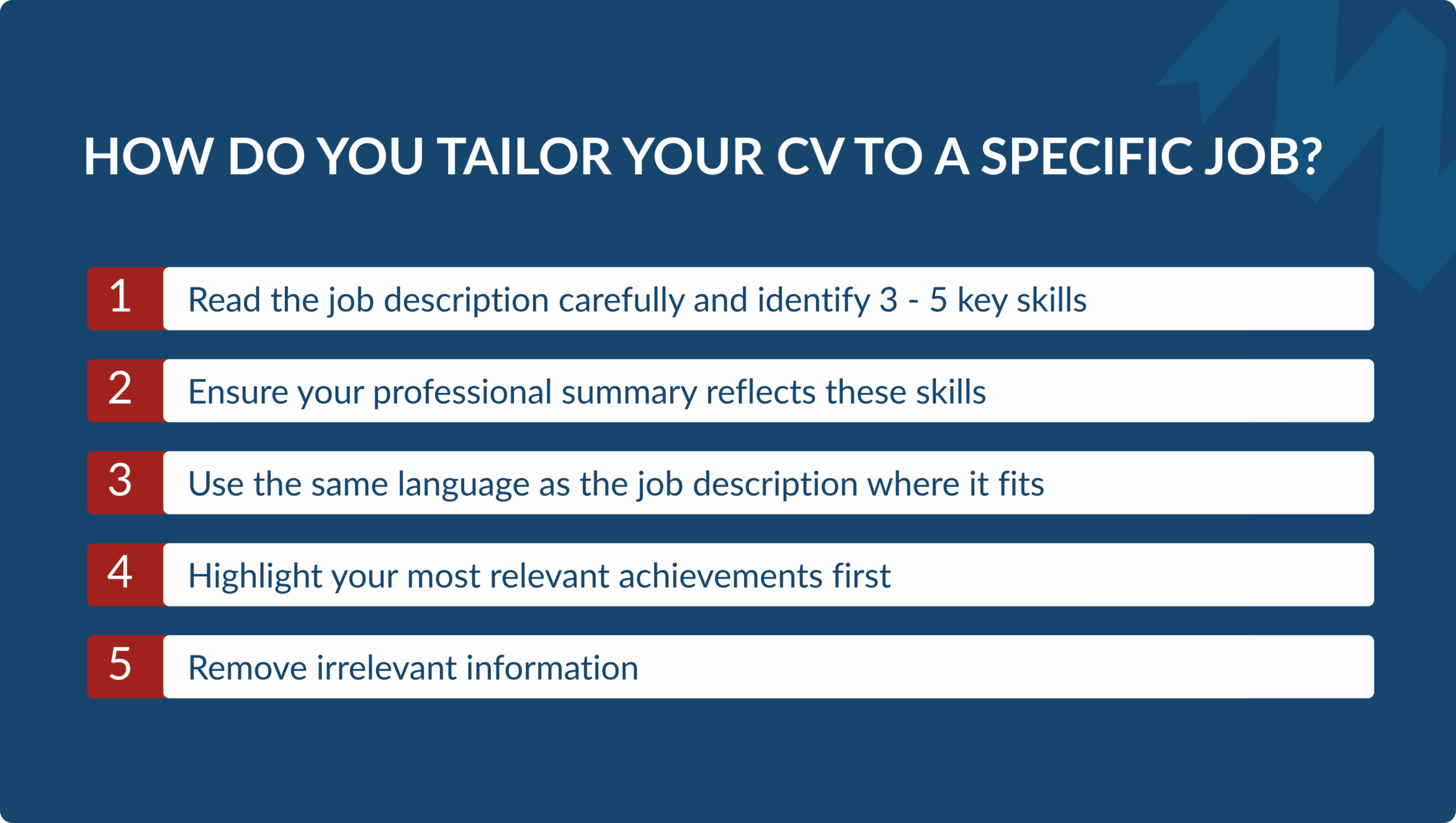
Step 1: Read the job description carefully. Identify the three to five key skills or experiences it highlights. These often appear first or are repeated. For example, a Compliance Officer role might stress MFSA regulatory knowledge and attention to detail.
Step 2: Ensure your professional summary reflects these priorities. If iGaming experience is valued and you have it, make sure it appears prominently.
Step 3: Reorder or rewrite your bullet points to highlight your most relevant achievements first. If you have project management experience, list your best example at the top of your most recent relevant position.
Step 4: Use the same language as the job description where it fits. If the employer says “client relationship management,” use that phrase instead of “account handling.”
Step 5: Remove or minimise irrelevant information. A senior IT role doesn’t need extensive details about early administrative duties. Trim it down to one line or cut it entirely.
Sector-specific signals that matter in Malta
Different sectors in Malta have different expectations. Here are the patterns our specialist teams observe:
| Sector | What recruiters look for |
| Finance & Accounting | Qualification (ACCA, CPA), software familiarity (SAP, Sage, Xero), specific reporting standards (IFRS, GAAP) |
| iGaming & Tech | Technologies and tools listed explicitly, product or platform names, regulatory awareness (MGA licensing) |
| Legal & Compliance | Regulatory bodies named (MFSA, FIAU), areas of law specified, language skills (especially Maltese for local work) |
| Marketing & Sales | Metrics-led achievements, channels specified, tools listed (CRM, analytics platforms) |
| Administration & Operations | Software proficiency (MS Office, ERP systems), process improvement examples, languages |
The principle is the same across all sectors: be specific. “Experienced in financial services” tells a recruiter very little. “Four years in funds administration under MFSA oversight, covering NAV calculation and investor reporting” tells them a great deal.
What small CV mistakes cost candidates interviews in Malta?
These are the common errors our recruiters notice. They may seem minor, but they can impact screening decisions.
An unprofessional email address. Use something like firstname.lastname@gmail.com. Avoid old nicknames or random numbers. If needed, create a new address before applying.
Including your date of birth. Under EU anti-discrimination rules, employers in Malta shouldn’t ask for this. Adding it may show you’re unaware of current practices. Just leave it off.
Overstating language skills. Malta is bilingual, and language skills are often tested in interviews. If your Maltese is conversational, say “conversational.” If your Italian is working-level, say “working proficiency.” Claiming fluency you don’t have can hurt your credibility when a recruiter speaks with you.
A poorly named file. “CV.pdf” isn’t helpful when a hiring manager has many attachments. Use “Firstname-Lastname-CV-2026.pdf” to identify yourself and show professionalism.
Spelling and grammar errors. Read your CV aloud. Have someone proofread it. Then read it again. A single typo on the first page can raise doubts about your attention to detail, even for roles that don’t focus on writing.
No clear career trajectory. A CV listing unrelated roles without a clear story is hard to assess. Even if your career has taken twists, a good professional summary can present those changes as intentional growth rather than confusion.
Once your CV is in good shape, the next step is performing well in the interview itself. See our complete job interview preparation guide for Malta for what to expect and how to prepare.
Browse current vacancies and register your CV on Konnekt. Our recruiters review every registration and will be in touch if there is a match in our current pipeline.
Frequently asked questions
In the first scan, typically 8 to 12 seconds, recruiters look for three things: your most recent role and employer, your seniority level, and whether your core skills match the vacancy. If these are not visible in the top third of page one, the CV is at risk of being filtered out before the content is read. Structure and positioning matter as much as what you write.
Yes, but the process does not need to be a full rewrite. Read the job description and identify the two or three skills it emphasises most. Check that those skills are visible in your professional summary and reflected in your top bullet points. Mirror the employer’s language where it fits naturally – ATS systems respond to keyword alignment, and so do human readers. A targeted 20-minute adjustment per application makes a measurable difference to your shortlist rate.
Focus on scope and standard rather than metrics. “Managed compliance reporting for a portfolio of 40 regulated entities under MFSA oversight” is an achievement statement even without a percentage attached. Think about volume, complexity, the regulatory or technical standard you worked to, and any improvements you made to processes. Every role has something that can be framed as contribution, not just activity.
Yes, and it is the most underused section we see. A strong professional summary tells a recruiter within 30 seconds who you are, at what level, and what you are looking for. Without it, they have to infer all of this from your job titles and experience. Three to five sentences stating your current level, core specialisms, and career direction is all you need. Be specific. “Experienced finance professional” is not a summary, but “ACCA-qualified Finance Manager with eight years in financial services, specialising in management accounts and regulatory reporting” is.
Very. Malta’s job market is bilingual (Maltese and English), and many roles in finance, legal, and iGaming have English as a baseline requirement. For roles involving local clients or public-sector interaction, Maltese proficiency is a genuine advantage. Additional European languages like Italian, French, German are valued across most sectors. List each language with an honest proficiency level. Recruiters in Malta test language skills at interview, so accuracy here protects your credibility.

About the author: Emma joined Konnekt in 2021 and has been working in recruitment ever since. She began her career as a Recruitment Specialist within the Finance & Legal Recruitment Team before expanding her expertise across other sectors, including Tech. Over the years, she progressed in her role and now oversees all recruitment teams in her current position as Recruitment Operations Manager.