How to write a resignation letter in Malta


Last updated
June 12, 2026
Share on


A resignation letter in Malta is a formal notice that you are leaving your job. According to the Employment and Industrial Relations Act (Chapter 452 of the Laws of Malta), you must follow a set notice period when terminating employment. Submitting your resignation in writing marks the official start of that period. Your letter should include the date, a clear statement of resignation, your employer’s name, and your last working day. You do not have to give a reason for leaving. Typically, most people first announce their resignation verbally, then send a written letter or email. The verbal notice is a professional courtesy, but the written version protects you legally and administratively.
What is a resignation letter and do you actually need one?
A resignation letter is a formal way to inform your employer that you are leaving your job. It should be addressed to your direct manager and kept in your employment file. This letter marks the official start of your notice period.
You may be asking if a resignation letter is necessary. The answer is yes – always.
In Malta, Chapter 452 requires that employment contracts include a statutory notice period. If there’s a dispute about when your notice started, for instance, if your employer claims you resigned later than you did, your written resignation letter will serve as proof. Without it, you only have your word.
Most candidates working with Konnekt follow this approach: first, speak with your manager. Giving verbal notice is a professional courtesy. It allows your employer to respond before the formal process starts. Then, send your written letter or email the same day or within 24 hours. This way, the record closely follows your conversation and the details remain fresh.
Emailing your resignation is completely acceptable. You can attach a signed PDF or write the letter directly in the email. Just make sure to keep a copy of what you sent.
What notice period applies in Malta?
Your notice period is governed by two things: the statutory minimums set out in Chapter 452, and any contractual notice period in your employment contract. Your contract may require more notice than the legal minimum, the contractual period applies. If your contract is silent on notice, the statutory minimum is what governs.
Here are the statutory minimums based on your length of service:
| Length of service | Minimum notice period |
| 1 month – 6 months | 1 week |
| 6 months – 2 years | 2 weeks |
| 2 years – 4 years | 4 weeks |
| 4 years – 7 years | 8 weeks |
| 7 years – 8 years | 9 weeks |
| 8 years – 9 years | 10 weeks |
| 9 years – 10 years | 11 weeks |
| 10 years or more | 12 weeks |
Always check your contract before calculating your last day. Many jobs in Malta, especially in finance, legal, and senior management, have notice periods of three months. These periods are longer than the statutory minimums.
One important scenario is garden leave. Some employers, especially in sensitive sectors, may require you to serve your notice at home. You stay employed and on the payroll, but you don’t need to come in. This is legal in Malta if it’s in your contract. If your employer suggests this, get the arrangement in writing.
If you are a third-country national on a Single Permit: your job and permit are linked. Resigning brings different obligations. Read our guide on what TCNs need to do when leaving a job in Malta before you submit your resignation letter.
What to include in your resignation letter
Keep it short. A resignation letter is a formal document, not a personal statement. Five short paragraphs are the maximum most situations warrant.
The essential elements are:
- Date – the date you write the letter, not your last day
- Addressee – your direct manager by name; not HR, or a generic “To Whom It May Concern”
- Statement of resignation – state clearly that this is your formal resignation and name the company (if the organisation has multiple entities, name the correct one)
- Last working day – give a specific calendar date, not “four weeks from today”; calculate it and write the actual date
- Gratitude – brief and genuine; one or two sentences acknowledging the experience or opportunity, which is expected in Malta’s market
- Offer to assist with the transition – a general offer is enough; you do not need to commit to specific tasks here
- Closing phrase and signature
What to leave out:
- Do not include the reasons you are leaving, even if you feel strongly about them. You are not legally required to, and in most cases, it adds no value while creating the potential for conflict. If you want to share feedback, do it verbally or through a structured exit interview – not in a document that will be kept in your file indefinitely.
- Do not criticise your manager, colleagues, or the company’s processes. It may be tempting, but it is best to avoid it.
A resignation letter template for Malta
[Date]
Dear [Manager’s first name and surname],
Please accept this as my formal resignation from [Name of the Company]. My last day of work will be [specific date], which reflects the [X weeks/months] notice period set out in my employment contract.
I want to express my genuine gratitude for the opportunities I have had during my time here. Working with you and the team has been a valuable part of my career, and I am grateful for everything I have learnt in this role.
During my notice period, I am happy to focus on whatever handover or transition tasks would be most useful. Please let me know where you would like me to direct my attention.
I hope to stay in touch, and I wish you and the team every success.
Kind regards, [Your full name]
This template works for email as well. If you are sending it by email, the subject line should be: Resignation: [Your Name], [Job Title]. Attach a signed PDF version if you want a formal record, or keep it in the email body.
What to do if you receive a counter-offer
A counter-offer happens when your employer, after getting your resignation, tries to keep you. This often includes a pay rise, a new title, or a promise of future opportunities.
It’s crucial to think this through before you resign, not after.
Recruiters often see a pattern: counter-offers tackle the visible reasons for leaving, like pay or title, but rarely fix the real issues. If you want to leave due to management style, lack of freedom, a poor fit, or a clear career ceiling, a pay rise won’t change those factors. The workplace remains the same. Once you resign, the trust with your employer changes, even if you stay. Many who accept counter-offers find themselves job hunting again within six months.
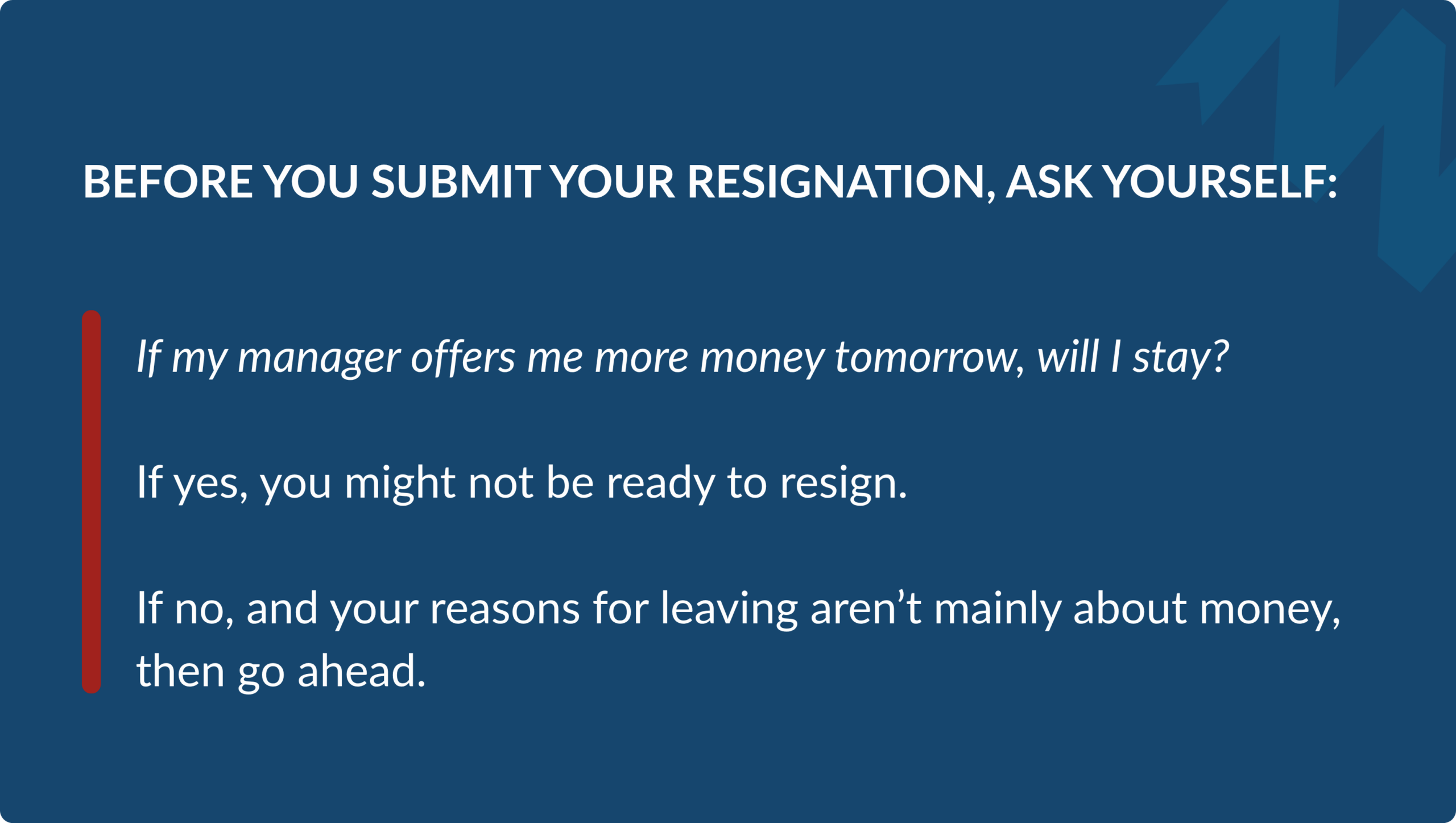
In Malta, it’s better to decline gracefully than to accept and leave a few months later. The job market is small, and your choice will be noticed and remembered.
Why resigning well matters more in Malta than anywhere else
Malta has a workforce of about 300,000. The professional community in fields like finance, iGaming, IT, or law is quite small. Statistically, your current manager could be a client, contact, reference, or decision-maker within five years.
You don’t owe your employer more than your notice period, and you shouldn’t stay in a role that isn’t right for you. However, how you leave matters a lot in Malta, more than in larger markets.
We advise candidates to resign as if they might need something from their former employer in two years. Given Malta’s small professional circle, this is likely.
Here are some practical points to keep in mind:
- Avoid calling in sick often during your notice period; people notice and remember.
- Don’t stop putting in effort once you’ve signed a new contract; finish your role properly.
- Don’t share details of your departure on LinkedIn or social media while still employed; your posts will be seen by people you know.
- If the exit conversation is tough, keep it short and professional; you don’t owe anyone a detailed explanation.
What next?
If you’ve signed your new contract and your resignation is the final step before starting your next role, you’re in a good position. Check your notice period before submitting your resignation letter and confirming a start date with your new employer.
If you’re resigning without having a new job lined up, have a look at our guides on creating a CV and preparing for job interviews.
Konnekt helps candidates at all stages of a career move, including those actively looking during their notice period. Browse current jobs in Malta or register with Konnekt to chat with a recruiter in your field.
Frequently asked questions
No. Under Maltese employment law, you are not legally obliged to state the reason for your resignation. You may choose to share feedback verbally or during an exit interview, but the resignation letter itself does not need to include a reason.
The minimum notice period depends on your length of service and is set out in the Employment and Industrial Relations Act, Chapter 452. Periods range from one week (for service of less than six months) to twelve weeks (for ten or more years). Your employment contract may require a longer period. Check your contract, as the contractual notice takes precedence if it exceeds the statutory minimum.
Yes. An email resignation is legally valid. The standard practice is to tell your manager verbally first, then follow up with a written email the same day or within 24 hours. Attaching a signed PDF gives you a cleaner record, but the email itself is sufficient.
If you leave without serving the required notice, your employer may be entitled to deduct the equivalent pay from any outstanding amounts owed, or pursue a claim for breach of contract. This is relatively uncommon in practice, but the legal right exists. Unless your employer explicitly waives the notice period in writing, serve it.
Think about why you decided to leave in the first place. If the reason was primarily financial and the counter-offer addresses it, you may have a genuine decision to make. If the reason was anything other than salary such as management, culture, growth, fit, a counter-offer is unlikely to change the underlying situation. Candidates who accept counter-offers and stay often find themselves back on the market within months.
Yes. If you are a third-country national working in Malta on a Single Permit, your permit is tied to your specific employer. Resigning does not simply mean working out your notice and leaving. There are immigration steps involved, and a limited grace period applies after your employment ends. Read our dedicated guide on the TCN grace period in Malta before resigning.

About the author: Emma joined Konnekt in 2021 and has been working in recruitment ever since. She began her career as a Recruitment Specialist within the Finance & Legal Recruitment Team before expanding her expertise across other sectors, including Tech. Over the years, she progressed in her role and now oversees all recruitment teams in her current position as Recruitment Operations Manager.